



Short answer: A paint system is a specified set of compatible coatings applied in sequence over a prepared surface: primer, fairing filler where needed, undercoats and a topcoat above the waterline, or barrier coats and antifouling below it. Paint system application is the controlled process of preparing the surface and applying those layers to the coating manufacturer’s specification, with temperature, humidity, dew point, film thickness and curing times controlled and checked at each stage. On a yacht, the result is judged on both protection and appearance, so inspection runs through the whole job, not only at the end.
Whether you’re involved in yacht ownership, maintenance or refit planning, the finish says a lot about a yacht. A mirror-like hull or superstructure is not only about style; it is about protection, performance and value. A paint system is not “painting the boat”. It is a planned, layered process, and each layer depends on the one beneath it.
Understanding how a paint system works helps you make better decisions during a build, a refit or ongoing maintenance. For how preparation, fairing and coating are organised in a yard period, see superyacht painting and repaint.
What Is in a Yacht Paint System?
| Layer | Purpose | Typical checks |
|---|---|---|
| Surface preparation | Remove old coatings, contamination and corrosion; create the profile the primer needs to bond | Cleanliness grade, surface profile, dust and salt contamination, substrate condition |
| Primer | Adhesion to the substrate (aluminium, steel or composite); corrosion protection on metal substrates | Product and mix ratio, dry film thickness, overcoating window |
| Fairing filler | Builds a fair, smooth surface where long lines and reflections are visible | Fairness with battens and light, filler thickness, cure before sanding |
| Undercoats (high-build and sealer coats) | Seal the filler, refine smoothness and give the topcoat a uniform base | Sanding grade, film thickness, defects before topcoat |
| Topcoat | Colour, gloss and UV resistance; the visible finish | Gloss, distinctness of image (DOI), orange peel, colour, film thickness |
| Antifouling system (underwater hull) | Barrier and tie coats plus antifouling to limit marine growth | Number of coats, thickness, waterline accuracy, launch window |
The exact products, number of coats and film thicknesses come from the coating manufacturer’s specification for that system. Products from different systems are not mixed unless the manufacturer confirms compatibility.
Surface Preparation Comes First
Many coating failures can be traced to the surface beneath the paint. Before any primer goes on, old coatings may need to be removed, the substrate cleaned and the surface given the profile the primer requires. On steel this is often abrasive blasting to a defined cleanliness grade such as Sa 2½; on aluminium and composite, the preparation follows the coating manufacturer’s instructions for that substrate. This is also the stage to check for corrosion, damage or moisture in the substrate, and on GRP yachts for signs of osmosis.
Preparation also decides whether an existing system can be built upon or has to come off. That decision depends on adhesion, the condition and thickness of the old layers and their compatibility with the new products.
How the Process Works in Practice
A high-quality paint job does not happen overnight. The process can take weeks or months, depending on the size of the yacht, the surfaces involved and how much of the old system is removed. It usually follows these steps:
- Assessment and specification. The existing surface, the substrate and the target finish are reviewed, and the coating system, products and inspection points are agreed.
- Containment and climate control. The work area is enclosed, typically with scaffolding and tenting, so temperature, humidity and dust can be controlled.
- Surface preparation and priming. Blasting, sanding or chemical treatment, followed by cleaning and checks, then the specified primer.
- Fairing. Filler is applied and sanded until the surface is fair; see fairing for how this stage is planned and checked.
- Layered application. Each coat is applied within the manufacturer’s overcoating window, with drying and curing times respected between coats.
- Inspection between stages. Thickness, cleanliness, ambient conditions and surface defects are checked before the next layer, often at agreed hold points.
- Topcoat and final finish. The topcoat is applied and checked for gloss, DOI and defects. Whether it can be polished afterwards depends on the paint type (see the technical notes below).
Application conditions are part of the specification. Coating data sheets set limits for air and surface temperature and relative humidity, and the surface temperature is normally required to stay at least 3 °C above the dew point so that moisture does not condense under the film. Any contamination during application, like dust or moisture, can compromise the finish and require rework.
Technical notes:
- For metallic paints, retouching is generally avoided. Because of their reflective nature and the way metallic flakes align, colour consistency is difficult to achieve. If repair is needed, the affected area is typically cut along a defined line and fully repainted.
- Acrylic paints can be polished or buffed when needed (for example, to correct local imperfections), but polyurethane topcoats should not be polished, as it can damage the finish.

Çiğdem Acar – Surface Treatment and Coating Inspector, FROSIO – LEVEL III at KRM Yacht
How a Paint System Is Inspected
Inspection is what turns a paint job into a documented paint system. The checks below are typical; the agreed specification decides which apply and their acceptance limits.
| Check | What it confirms | Common reference |
|---|---|---|
| Ambient conditions | Air and surface temperature, relative humidity and dew point are within the data sheet limits | ISO 8502-4 |
| Surface cleanliness | The prepared surface meets the specified cleanliness grade | ISO 8501-1 (steel) |
| Dust and soluble salts | Contamination left on the surface before coating | ISO 8502-3, ISO 8502-6/-9 |
| Dry film thickness (DFT) | Each layer and the total system are within the specified thickness | ISO 2808; ISO 19840 on blast-cleaned rough surfaces |
| Adhesion | The coating bonds to the substrate and between layers | ISO 4624 (pull-off) |
| Gloss and appearance | Gloss at 20°, 60° and 85°; DOI, haze and orange peel measured with an appearance meter against the agreed specification | ISO 2813 (gloss only) |
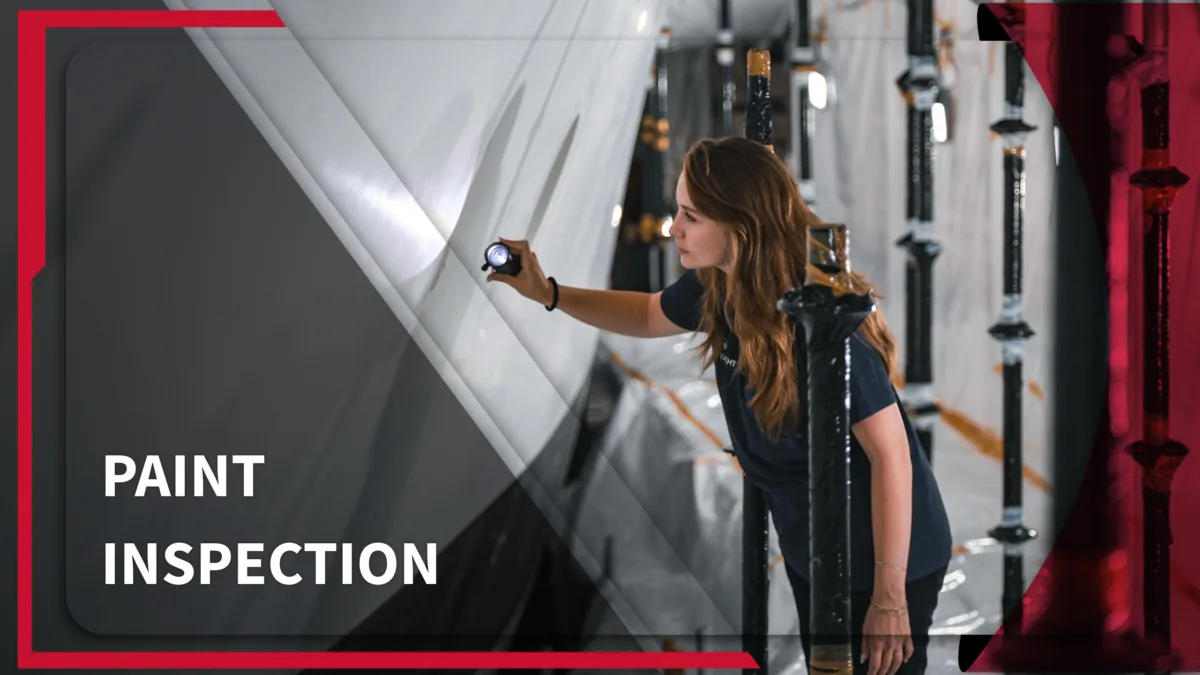
Results are recorded so the owner, the yard and the coating manufacturer share the same evidence, which also matters for any coating warranty. For how this works during a refit, see paint inspection.

Topcoat appearance readings at KRM Yacht: gloss at 20°, 60° and 85°, plus DOI, haze and Rspec, with mean and spread over 29 readings.
Where Paint Systems Are Applied on a Yacht
Paint system applications are most often carried out during new builds, major refits and full repaint cycles, when there is access to the hull and superstructure and the area can be enclosed for climate control.
| Area | What the system has to handle |
|---|---|
| Hull topsides | Appearance, UV, abrasion from fenders and tenders; usually a high-gloss topcoat over a faired surface |
| Superstructure | UV, heat and appearance; complex shapes and many fittings to mask |
| Underwater hull | Water immersion and fouling; barrier coats and an antifouling scheme |
| Masts and spars on sailing yachts | UV, load-related movement and fittings |
| Decks and non-skid zones | Foot traffic and grip; coatings with non-skid additives |
| Engine room floors and bilges | Oil, fuel, water and abrasion; high-durability coatings |
Every surface has its own requirements and may involve different primers, coatings or techniques. Paint systems can also include special finishes such as metallics, matte effects or clear coats.
Full Paint System, Repaint or Touch-Up?
| Option | When it makes sense |
|---|---|
| Touch-up or local repair | Damage is local and the surrounding system is sound; harder on dark colours, where blending is visible, and not normally done on metallics, which are cut back to a line and repainted |
| Repaint over the existing system | Adhesion and condition of the old system are good, and the new topcoat is compatible with it |
| Full paint system | The old system has failed, adhesion is poor, there is corrosion or substrate damage, the build-up of old layers is excessive, or the specified finish cannot be achieved over the existing system |
The decision is made after the existing coating has been inspected, not before. In a refit, painting is often one of the largest single items in time and budget, so it is planned with the rest of the yard schedule.
Common Misconceptions
It’s easy to confuse a paint system with a simple repaint. Many assume that a quick sanding and a fresh coat will do the job, but paint systems are about compatibility and layering. Mixing products or skipping surface preparation can result in major failures such as delamination, blistering or early fading.
Another misunderstanding is that more layers equal better protection. Film thickness has limits on both sides: too thin leaves the substrate underprotected, too thick can lead to cracking, solvent entrapment or poor curing. The quality of the process matters more than the number of coats.
Who Needs to Think About This?
If you’re a yacht owner, the paint system protects your investment and affects resale value. For captains and crew, a quality finish means fewer surface problems to manage over time. Management companies rely on predictable schedules and warranty-backed work. And for anyone planning a refit, paint is often one of the biggest single line items on the budget.
A paint system application isn’t just cosmetic. It is part of substrate protection, presentation and operational reliability.
Frequently Asked Questions
What is a paint system?
A specified combination of compatible coatings, applied in a set order and thickness over a prepared surface. On a yacht it typically includes primer, fairing filler where needed, undercoats and a topcoat above the waterline, and barrier coats with antifouling below it.
What is the correct order of a yacht paint system?
Surface preparation, primer, fairing filler where required, undercoats, then topcoat. Each layer is applied within the manufacturer’s overcoating window and checked before the next one.
How often should a yacht be painted?
There is no fixed interval. It depends on the quality of the original application, exposure to sun and salt, how the yacht is used and maintained, and how well the system has held up. Many yachts need local repairs or a topcoat refresh well before a full system is required; a full system is usually decided after an inspection shows the existing coating has failed or is no longer suitable.
How long does a superyacht paint job take?
It ranges from weeks to months, depending on the yacht’s size, how much of the old system is removed, the amount of fairing, curing times between coats and the climate control available. The schedule is set by the specification and inspection hold points, not only by the area to be painted.
Can I just repaint over old layers to save time and cost?
Only if the existing system is sound and compatible. Repainting without proper surface preparation and compatibility checks can lead to peeling, blistering or poor adhesion. An inspection decides whether the old system can be built upon or has to be fully removed.
What’s the difference between filling (fairing) and priming?
Filling, often called fairing when done on hull surfaces, smooths out imperfections with filler to create a fair surface, especially where long, straight lines are visible. Priming protects the substrate and gives the following layers something to bond to.
Is it possible to change a yacht’s colour during a paint system application?
Yes, and many owners use a full repaint to refresh or change the yacht’s appearance. Darker and metallic colours may need different techniques and maintenance expectations than lighter shades; dark colours absorb more heat, and metallics are harder to touch up.
How can you tell if a paint system was poorly applied?
Early signs include fading, chalking, bubbling or blistering, poor adhesion, and visible filler seams or print-through under the topcoat. These can result from rushed application, poor surface preparation, wrong film thickness or contamination during curing.
Does the environment where painting happens really make a difference?
Yes. Dust, humidity, temperature and dew point all affect adhesion, curing and finish quality. That is why yacht painting is usually done in climate-controlled tents or sheds that meet the coating manufacturer’s requirements.
Is a high-gloss finish harder to maintain than a matte or satin one?
Each needs different care. Gloss finishes show scratches and swirl marks more readily, and some can be polished locally depending on the paint type. Matte and satin finishes usually cannot be polished, can show fingerprints, oils and scuffs, and need the manufacturer’s dedicated care products so they do not burnish and go shiny.
What should a yacht owner ask a yard before a repaint?
Which coating system and manufacturer will be used, how the existing coating will be assessed, how the area will be enclosed and climate-controlled, which inspections and hold points are planned, who carries out the coating inspection and what records and warranty conditions will be provided at the end.