

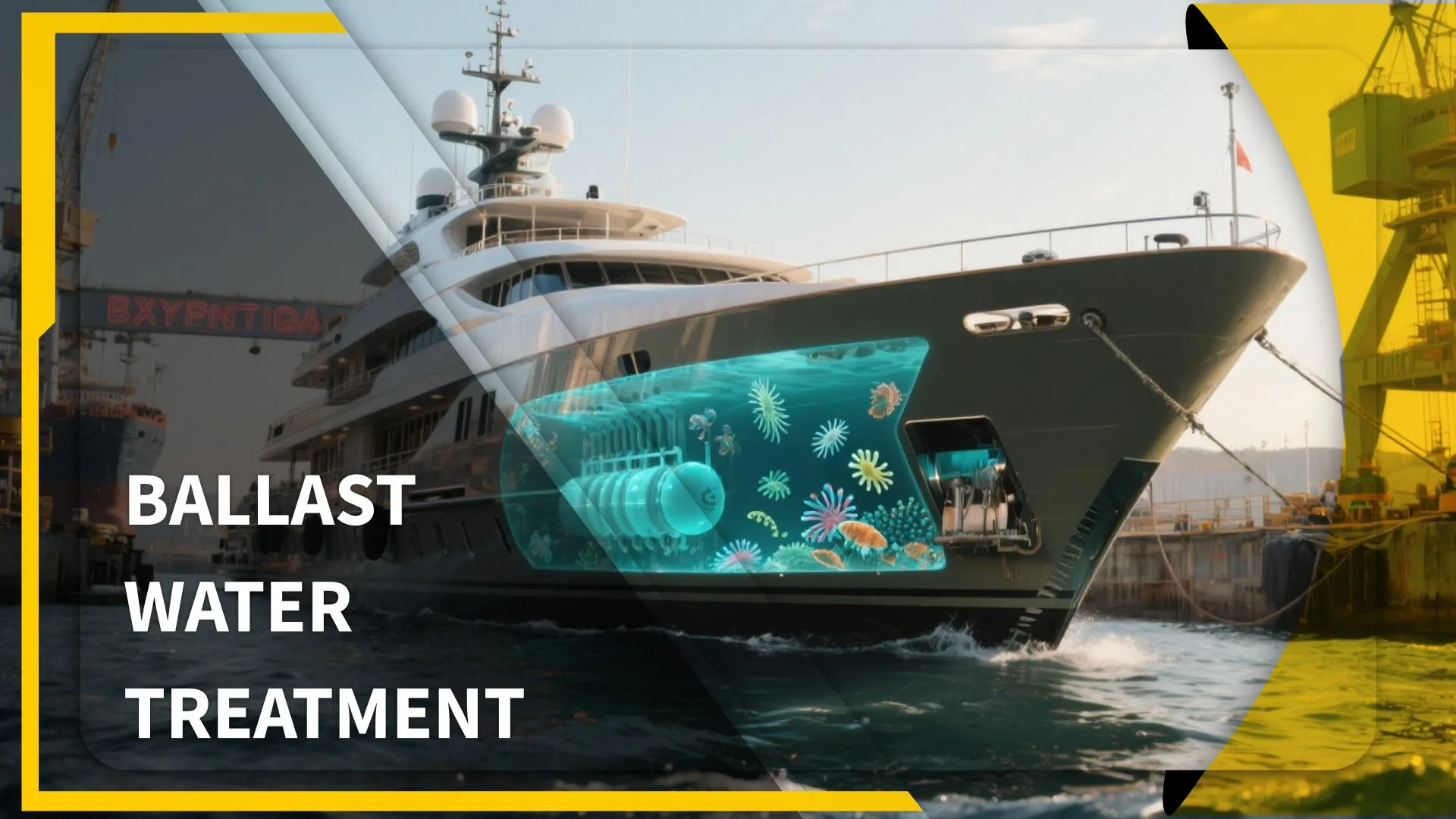
Short answer: Ballast water treatment is the onboard process of removing or killing organisms in ballast water before it is discharged, so that ships do not move invasive species between sea areas. Under the IMO Ballast Water Management (BWM) Convention, ships in scope must meet the D-2 discharge performance standard, normally with a type-approved ballast water management system (BWMS) that combines filtration with a disinfection stage such as UV or electrochlorination. Yachts are generally in scope if they are designed to carry ballast water and operate internationally; the 400 GT figure decides survey and certification, not whether the rules apply. Retrofitting a system is a refit package that touches space, piping, power, automation, class and flag approval and commissioning testing.
If you’ve spent time around yachts or commercial vessels, you may have heard about ballast water and, increasingly, ballast water treatment systems. It might sound like a niche technical detail, but it has real environmental and operational consequences for anyone involved in yacht operations, management or refits. For a short definition, see the ballast water treatment glossary entry.
Why Ballast Water Treatment Matters
When a vessel takes on ballast water for stability, trim or draught, it also takes in marine life: plankton, bacteria, larvae and small organisms. That water is often discharged in a different part of the world, where those organisms may not belong. Invasive species carried this way can disrupt local ecosystems, fisheries and coastal infrastructure.
The BWM Convention entered into force on 8 September 2017. It requires ships in scope to manage ballast water and sediments under an approved Ballast Water Management Plan and to keep a Ballast Water Record Book.
D-1 and D-2: The Two Standards
| Standard | What it requires | Status |
|---|---|---|
| D-1: ballast water exchange | Exchange ballast water at sea, with at least 95% volumetric exchange | Transitional option during the phase-in; ships in scope now have to meet D-2 |
| D-2: ballast water performance | Discharge must stay below set limits for viable organisms and indicator microbes: fewer than 10 viable organisms per cubic metre that are 50 micrometres or larger, fewer than 10 per millilitre that are at least 10 but less than 50 micrometres, and limits for indicator microbes such as E. coli and Vibrio cholerae | The standard ships in scope now have to meet |
The phase-in for existing ships was tied to their IOPP renewal surveys from 8 September 2019 and ended on 8 September 2024. In practice, ships in scope meet D-2 with a BWMS approved by the flag Administration under the IMO BWMS Code.
Does a Yacht Need a Ballast Water Treatment System?
It depends on the yacht, not only on its size.
| Situation | What it means |
|---|---|
| The yacht is not designed or constructed to carry ballast water | The Convention does not apply |
| Ballast is permanent, in sealed tanks, and not discharged | Excluded from the Convention |
| The yacht flies the flag of a Party and only operates in waters under that Party’s jurisdiction | Can be excluded under Article 3.2, subject to the conditions set by that Party |
| 400 GT and above, in scope | Initial and renewal surveys, an International Ballast Water Management Certificate, a BWM Plan and a record book |
| Below 400 GT, in scope | No international certificate, but the Convention still applies; the flag Administration sets how compliance is shown |
| Pleasure craft used solely for recreation or competition, under 50 m LOA, with a maximum ballast capacity of 8 m³ | Still in scope, but may comply through equivalent compliance under Regulation A-5, determined by the flag Administration using IMO guidelines |
Many motor yachts have no dedicated ballast water system, while others carry ballast or trim tanks that are filled and discharged at sea. Whether the Convention applies, and how, is confirmed with the flag Administration and the classification society. In US waters, United States Coast Guard rules apply separately, including their own type-approval regime for treatment systems.
How Ballast Water Treatment Systems Work
Most systems use two stages: solid-liquid separation to remove sediment and larger organisms, followed by disinfection of what remains.
| Method | How it works | What to consider on a yacht |
|---|---|---|
| Filtration | Automatic backflushing screen filters remove sediment and larger organisms on uptake | Pressure drop, filter size and backflush handling |
| UV treatment | UV light damages organisms’ DNA so they cannot reproduce; usually applied on uptake and again on discharge | Compact and chemical-free, but power demand rises with flow, and performance depends on water clarity (UV transmittance) |
| Electrochlorination | Electrolysis of seawater produces an active oxidant that kills organisms; residual oxidant is neutralised before discharge | Suits higher flow rates; needs neutralisation and gas handling, and performance can depend on salinity |
| Chemical injection | A stored biocide is dosed into the ballast water and neutralised before discharge | Chemical storage, handling and crew training; holding time before discharge |
Systems that use an Active Substance, such as electrochlorination or chemical injection, also need IMO Basic and Final Approval under the G9 procedure. Every system has operating limits, such as minimum holding time, water salinity and temperature, and these have to suit the yacht’s cruising areas.
Retrofitting a Ballast Water Treatment System During a Refit
On a yacht, a retrofit is rarely a single box. It connects to ballast pumps, piping, the sea chest arrangement, tank layout, power supply and automation. The usual sequence is:
- Applicability check. Confirm with the flag Administration and class whether the yacht is in scope and which standard applies.
- Survey and system selection. Measure ballast pump capacity, pipe routes and the free space in technical spaces, and choose a system type and size that fits the flow, power and operating profile.
- Engineering and approval. Prepare piping, electrical and arrangement drawings and obtain class approval where required. The BWM Plan is updated for the new system.
- Installation. Pipework, valves, sampling points, cabling and control integration, often alongside other machinery work in the yard period.
- Commissioning and testing. For BWMS commissioning surveys completed on or after 1 June 2022, a commissioning test with sampling at the treated discharge and laboratory analysis is required as part of the survey.
- Crew training and records. The crew is trained on operation, alarms and maintenance, and records start in the Ballast Water Record Book.
Space and power are often the deciding factors on a yacht, so the system choice is made with the machinery and equipment scope and the yard schedule, and coordinated through project management once it becomes a live package. Commissioning sits with tests and surveying.
What Drives Retrofit Cost
There is no single price for a ballast water treatment retrofit. The main cost drivers are:
- System type and rated flow
- Available space and how much existing equipment has to move
- Pipework length, materials and the number of new valves and penetrations
- Power supply and electrical upgrades
- Engineering, class approval and commissioning testing
- Whether the work fits into a planned yard period or needs its own downtime
Comparing offers on the same flow rate, scope and approval path gives a more useful picture than comparing equipment prices alone.
Operation and Maintenance
A treatment system only stays compliant if it is operated and maintained correctly. Typical tasks include filter cleaning and inspection, UV lamp and sensor checks, calibration of monitoring equipment, consumables for chemical systems, and keeping the Ballast Water Record Book and system logs up to date. The manufacturer’s manual and the BWM Plan set the routine.
Not to Be Confused With
Ballast water treatment is sometimes mixed up with bilge water management, but they serve different purposes. Bilge water comes from machinery spaces and can contain oil or fuel residues, so the concern is pollution. Ballast water is seawater taken on for weight and trim, and the concern is mainly biological.
Frequently Asked Questions
What are the requirements for a ballast water treatment system?
A ship in scope needs an approved Ballast Water Management Plan, a Ballast Water Record Book, and discharges that meet the D-2 standard, normally through a BWMS type-approved by the flag Administration under the IMO BWMS Code (plus G9 approval for Active Substance systems). Ships of 400 GT and above also carry an International Ballast Water Management Certificate, and a BWMS commissioning survey completed on or after 1 June 2022 includes a commissioning test with discharge sampling and laboratory analysis. US waters additionally require USCG type approval.
Does every yacht need a ballast water treatment system?
No. The BWM Convention does not apply to vessels not designed to carry ballast water or with permanent ballast in sealed tanks. Yachts that do carry and discharge ballast water on international voyages are generally in scope regardless of tonnage; the 400 GT threshold decides certification, not applicability. Pleasure craft under 50 m with no more than 8 m³ of ballast are still in scope but may comply through equivalent compliance under Regulation A-5, as set by the flag Administration.
What is the difference between D-1 and D-2?
D-1 was ballast water exchange at sea, a transitional option during the phase-in that ended on 8 September 2024. D-2 is a performance standard that limits the number of viable organisms in the discharged water, which in practice requires a treatment system.
What is the most effective way to treat ballast water on a ship?
There is no single best method. Filtration combined with UV or electrochlorination is a common approach, within each system’s approved operating limits. The right choice depends on flow rate, available space and power, water conditions in the operating areas, and the approvals the vessel needs.
Can a ballast water treatment system be retrofitted during a refit?
Yes. Retrofits are commonly done in a refit period because they need space planning, pipework, electrical integration, class approval and commissioning testing. Planning early avoids clashes with other machinery work.
How much does a ballast water treatment retrofit cost?
It varies widely with system type and flow rate, the space available, pipework and electrical work, engineering and approvals, and downtime. Compare offers on the same scope and flow rate.
What does “IMO approved” mean for a ballast water treatment system?
The system has been type-approved by a flag Administration under the IMO BWMS Code, and systems using Active Substances have also passed IMO Basic and Final Approval under the G9 procedure. For US waters, USCG type approval is needed separately.
What happens if a yacht does not comply?
Port State control can inspect the certificate, the BWM Plan and the record book and may sample the discharge. Non-compliance can lead to deficiencies, restrictions on discharging ballast, fines or detention, depending on the port State.
Does ballast water treatment affect stability or performance?
It does not change what the ballast is for, but it can affect operations. The system adds weight and takes space, the filter adds pressure drop that can reduce ballast flow, and operating limits such as holding time, salinity or water clarity can restrict when ballast is taken on or discharged. These are checked in the retrofit engineering.
What maintenance does a ballast water treatment system need?
Filter cleaning, UV lamp and sensor checks, calibration, consumables for chemical systems, crew training and up-to-date records, following the manufacturer’s manual and the BWM Plan.