
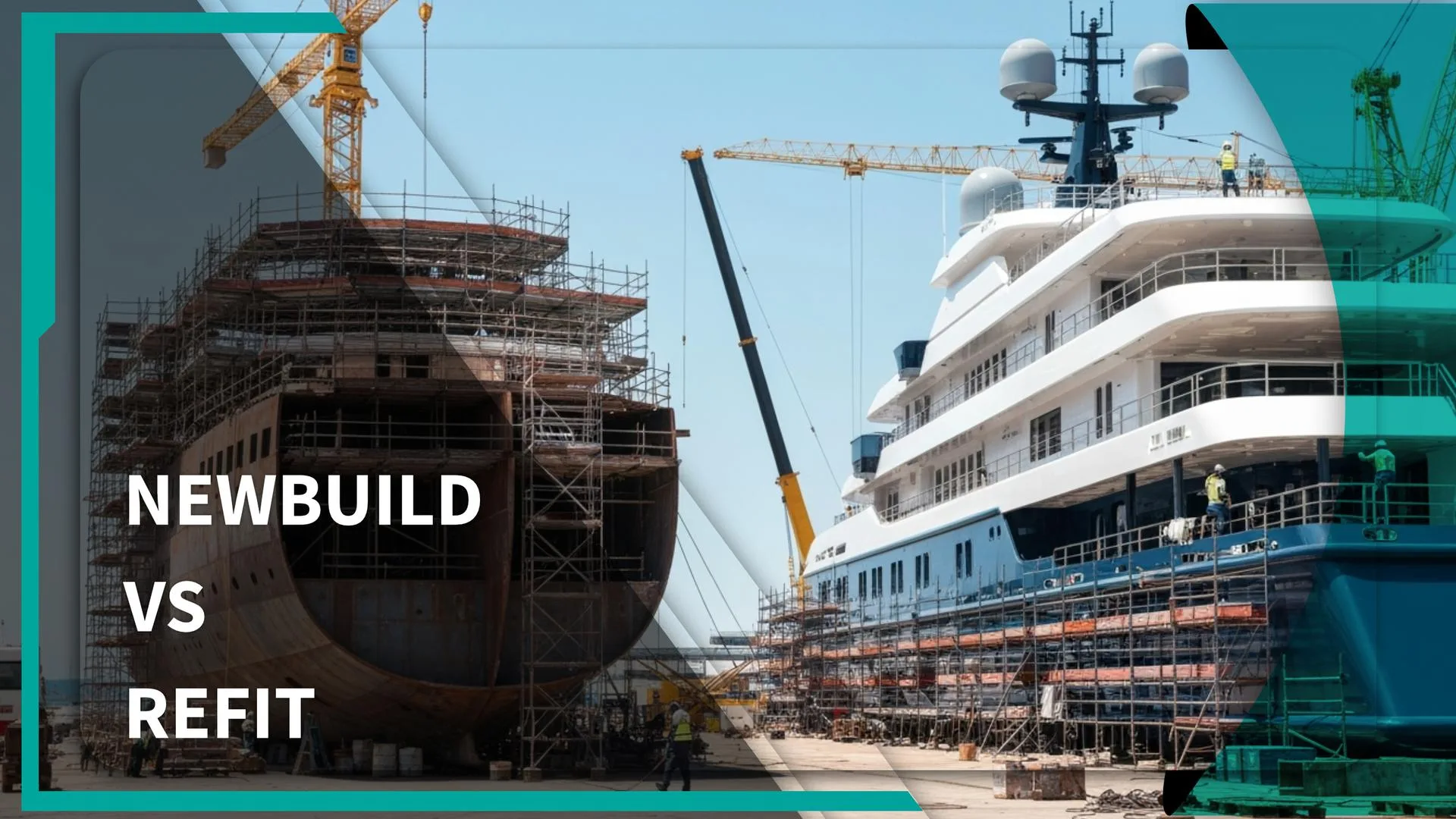
New build and refit solve different ownership problems. A new build starts with a fresh platform, a full specification path and a long design-to-delivery route. A refit starts with an existing yacht and asks how much value, reliability, capability and owner fit the yard period can recover or create.
The decision is commercial, technical and operational at the same time. It depends on the existing yacht’s condition, the owner’s mission, time pressure, design ambition, survey exposure, documentation quality, budget tolerance and appetite for project control. The right answer is the route that gives the owner the strongest vessel outcome for the capital, time and risk being accepted.
New build vs refit at a glance
| Decision area | Refit | New build |
|---|---|---|
| Starting point | Existing yacht with a known platform, service history and operating profile | Clean-sheet platform and engineering basis |
| Capital profile | Lower entry cost when the base yacht is right; budget strength depends on survey quality and contingency discipline | Higher upfront capital with a cleaner engineering and procurement baseline |
| Schedule | Can move faster toward yard start and relaunch; schedule shifts when opening-up work exposes hidden items | Longer delivery path overall; usually more predictable once design and specification are fixed |
| Design freedom | Strong for upgrades, renewals and some layout changes; bounded by structure, tankage, stability and service routes | Full control over layout, propulsion, technical rooms and future allowances |
| Risk profile | Discovery risk sits inside demolition, legacy systems, access limits and condition findings | Design-change risk sits inside specification growth, owner decisions and slot timing |
| Approval path | Existing class and flag basis can help, though modifications may trigger added review across affected areas | Approval package is built from zero around current rules and intended use |
| Best fit | Proven platform, defined upgrade brief, shorter route back to operation, or a yacht with value worth preserving | Full custom brief, long-horizon ownership plan, or no suitable existing platform |
The platform decides before the moodboard
Design ambition often arrives first, but the platform decides what the project will carry. In a new build, the platform is created around the mission: dimensions, volume, guest flow, crew flow, machinery philosophy, tankage, range, service access, noise control, redundancy and technical space are designed from zero.
In a refit, the platform already exists. The hull, structure, deck arrangement, engine room, accommodation layout, technical routes, class history, flag position and past maintenance records shape the possible outcome. That existing platform is an asset when it fits the owner objective. It becomes a constraint when the desired change asks too much from the structure, systems or approval path.
If the existing platform already supports the mission, the practical next route is Superyacht Refit.
The first decision is simple in principle: does the existing yacht already carry enough of the owner’s mission to justify investment, or is the owner trying to force a different yacht into the wrong platform?
New build gives the cleanest specification route
A new build gives the owner the strongest control over concept, layout, systems architecture, finish level and future service access. The yacht is designed around the intended operating profile from the beginning, with the technical baseline, documentation set and construction route developed together.
That freedom has a price. New build requires a longer commitment, heavier early specification work, design-freeze discipline, staged payments, build monitoring, approval follow-up, trials and a long handover path. Owner decisions made late in that process move drawings, procurement, production sequence and delivery.
New build is strongest when the owner wants a yacht that an existing platform cannot sensibly become: different dimensions, different volume, a new layout philosophy, a fresh technical baseline, a specific long-term operating profile or a full custom ownership idea.
Refit uses the value already inside the yacht
Refit becomes the stronger route when the existing yacht is fundamentally close to the mission. The owner keeps the platform, known seakeeping, general arrangement, records and operating history, then renews or upgrades the parts that limit the next ownership period.
That work ranges from cosmetic and interior-led renewal to paint, machinery, electrical, structural, survey-led and mixed yard packages. The commercial value comes from targeted transformation: the owner invests in the areas that move reliability, comfort, compliance, guest experience, resale confidence or operational readiness.
The key is scope realism. A refit works best when the project respects the existing yacht and gives the yard enough definition to price, sequence, inspect, prove and redeliver the vessel. If the work becomes a platform transformation, the refit label starts losing accuracy.
Capital exposure has a different shape
New build normally carries the larger capital envelope because the owner is funding design, engineering, construction, equipment, interiors, commissioning and delivery of a fresh vessel. The spend is staged over a longer route, and the commercial pressure sits around specification control, contract structure, change discipline and build monitoring.
Refit often begins with a smaller capital frame because the yacht already exists. The risk sits in a different place. Hidden condition, opening-up findings, legacy-system interfaces, access limitations, owner selections, survey comments and procurement shifts move cost after the yacht enters the yard.
That gives refit a different risk structure. The client team has to read refit cost through assumptions, provisional work, evidence, release requirements and redelivery condition. The deeper cost layer sits in yacht refit cost, but the strategic comparison belongs here: new build concentrates capital in creating the platform; refit concentrates capital in changing and proving the platform.
Time pressure often favours the existing platform
Schedule changes the decision quickly. A new build route carries concept development, design, engineering, procurement, construction, outfitting, trials and handover. It gives the owner control, but the yacht reaches operation through a longer route.
Refit works from a yacht already in existence. When the base vessel fits the mission, the owner uses a yard period to renew systems, recover finish, upgrade interiors, correct known defects, complete survey-driven work and return to service faster than a full construction route.
Time advantage still depends on scope discipline. A compressed refit with unstable decisions, late procurement, broad opening-up risk and weak approval planning loses its schedule advantage. Once timing, scope and yard control start taking shape, yacht refit planning becomes the next operational layer.
Design freedom has a structural boundary
New build gives the owner the cleanest path for layout ambition. Guest flow, crew routes, service spaces, engine-room access, hotel systems, deck use, noise control, storage, tenders, toys and future upgrade space are built into the yacht from the first design stages.
Refit design freedom depends on the existing structure. Bulkheads, tanks, deck heights, machinery spaces, shaft lines, cable routes, ventilation paths, fire boundaries and class-sensitive areas shape the efficient change envelope. Interior renewal and finish upgrades often deliver major improvement while leaving the platform intact. Layout transformation, machinery relocation or structural change creates a different level of engineering and approval exposure.
The useful question is whether the owner wants a better version of this yacht or a different yacht altogether. The first answer often supports refit. The second answer points toward new build or rebuild.
Technical risk moves to different places
New build starts with a clean technical baseline, but it still carries project risk. Specification drift, late design changes, procurement shifts, yard capacity, construction quality, commissioning problems and trial findings all have to be controlled across a long delivery route.
Refit carries the risks of an existing yacht. Opening-up reveals corrosion, dampness, old repairs, tired piping, obsolete controls, undocumented modifications, weak access or incompatible systems. The yard has to integrate new equipment with legacy structure, old routing, existing foundations and previous workmanship.
Both routes require discipline. New build risk is controlled through specification, build monitoring and acceptance stages. Refit risk is controlled through scope definition, condition review, opening-up strategy, variation control, surveys, tests, commissioning and evidence-led redelivery.
Governance is part of the route decision
The owner-side structure changes with the route. New build governance is heavy on specification, contract administration, design approvals, construction monitoring, change control, trials and delivery acceptance. The owner team has to protect the concept over a long period.
Refit governance is more compressed. Decisions move around scope, access, variations, owner selections, procurement, survey comments, package interfaces, commissioning, open items and redelivery. The ownership team has to keep technical movement and commercial movement connected during a shorter and more intense yard period.
For exposed refit periods, Superyacht Refit Project Management becomes part of the decision. A strong yard period is governed through a live project plan, with reporting built for owner decisions rather than decorative progress language.
The middle ground is rebuild
Some projects begin as refit decisions and then reveal a heavier route. Hull extension, structural renewal, deck transformation, major layout change, machinery relocation, broad systems replacement or approval-heavy conversion pushes the yacht beyond a standard refit frame.
At that point, Rebuild becomes the more accurate commercial and technical model. The owner keeps the base vessel, but the project begins to behave like a platform transformation. Engineering, documentation, approval strategy, production sequence and redelivery evidence become deeper than a conventional refit period.
When that threshold appears, the value of the early route comparison is simple: it reveals the right model before the owner commits to the wrong budget, schedule or contract logic.
The best route is the one the yacht defends
The strongest decision is rarely the route with the most attractive first story. It is the route the yacht, budget, schedule and owner objective defend under real project conditions.
New build is the stronger answer when the owner wants a fresh platform, broad design control, a new technical baseline and a longer ownership horizon built from zero. Refit is the stronger answer when the existing yacht already carries the mission and the owner wants targeted renewal, faster return to operation and controlled transformation of a known vessel.
The decision becomes easier when the owner team asks the yard-facing question early: what has to be designed, opened, changed, procured, approved, tested and handed back for this route to succeed?
Practical takeaway for owner teams
Choose refit when you already have the right yacht, the platform is structurally and operationally sound, and the job is to improve systems, spaces, finish quality, reliability and onboard use without starting from zero.
Choose new build when the project requires full freedom on layout, hull form, performance target, technical architecture or long-term ownership planning that depends on a fresh platform.
Choose rebuild when the yacht still has platform value, but the scope has expanded into structural, engineering and approval depth that goes well beyond a normal refit period.
If you are weighing an existing yacht against a clean-sheet build, gather the current class position, last survey findings, target season and the work packages you want to change first. That usually clarifies the route faster than broad budget talk.
For owners keeping the project on an existing platform, the right first review is superyacht refit. If the scope already points toward deeper reconstruction, go to rebuild.
If the route is already becoming commercially real, you can request a refit quote to review the vessel, scope and delivery logic.
FAQs
Is refit cheaper than new build?
Refit often carries a lower capital envelope because the owner is upgrading an existing yacht. The final comparison depends on vessel condition, scope depth, opening-up findings, approval exposure, owner selections and redelivery expectations.
When is new build the better route?
New build is stronger when the owner wants a fresh platform, wider design freedom, a clean technical baseline, a custom layout, long-term specification control and a full design-to-delivery route.
When is refit the better route?
Refit is stronger when the existing yacht already fits most of the mission and the owner wants to renew, upgrade or correct defined areas through a controlled yard period.
When does the decision move toward rebuild?
The decision moves toward rebuild when the project changes structure, layout, hull form, machinery position, major systems architecture or approval exposure deeply enough to become a platform transformation.
Who belongs in the new build vs refit decision?
The decision normally involves the owner, captain, yacht manager, owner’s representative, technical advisors and the yard or project team. The stronger decision combines owner intent with condition evidence, project control and realistic delivery planning.