

Glossary Term
EPIRB
An EPIRB, or Emergency Position Indicating Radio Beacon, is a specialized maritime safety device designed to send a distress signal when activated. Its job is simple but critical: alert rescue authorities that a vessel is in trouble, while providing the vessel’s exact location. Unlike standard communication equipment, which relies on manual operation and good conditions, an EPIRB transmits via satellite networks monitored globally. That means even in the middle of the ocean, far outside cellular or VHF range, the beacon can still call for help.

Why an EPIRB Matters on Yachts
Yachts often operate far from immediate assistance, and conditions can change in minutes. A fire in the engine overhaul room, damage to the propulsion system, or flooding that overwhelms the piping & plumbing system are real risks. In each of these cases, traditional communication may fail quickly.
This is where the EPIRB steps in. Once activated, either manually or automatically if the yacht sinks, it transmits a signal with the vessel’s identity and coordinates. Authorities like coast guards and rescue centers can then mobilize help immediately, often coordinating with international frameworks under IMO and SOLAS requirements.
How an EPIRB Works
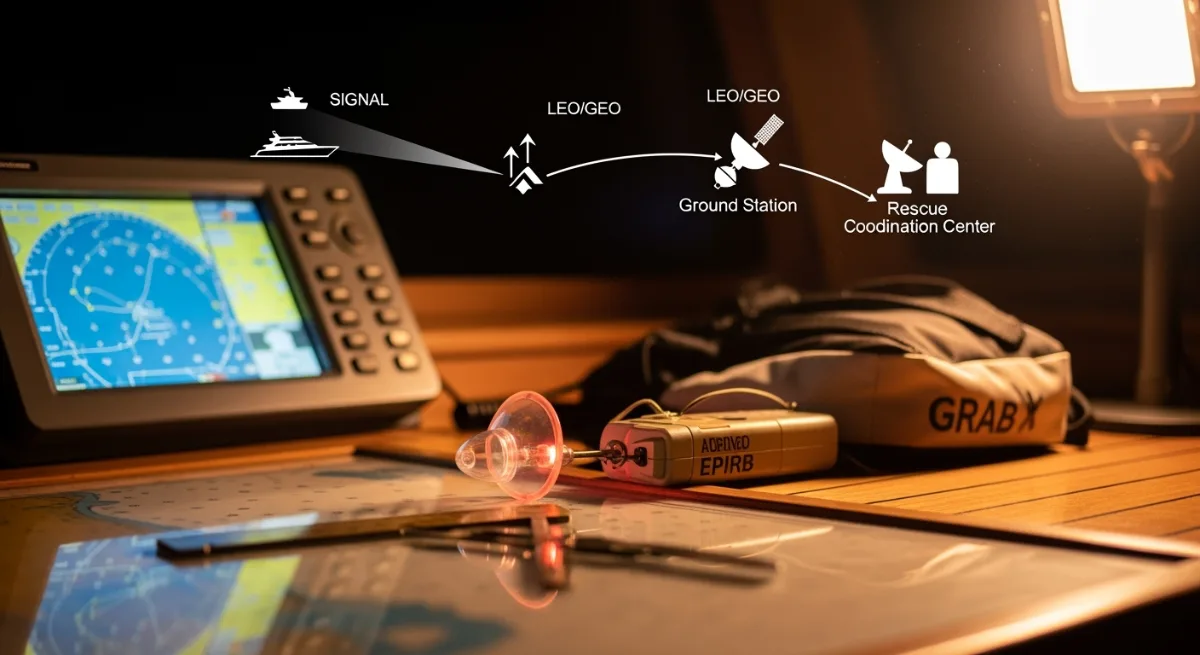
The device is equipped with a GPS receiver and a powerful transmitter. When triggered, it sends a coded message to satellites in the Cospas-Sarsat system, a worldwide search and rescue satellite network. The signal is then relayed to ground stations and forwarded to the nearest rescue coordination center.
Modern EPIRBs often feature strobe lights to increase visibility in darkness and can transmit for at least 48 hours. They are built to float, withstand rough seas, and operate even after prolonged immersion in saltwater.
Common Misunderstandings
Some people confuse EPIRBs with Personal Locator Beacons (PLBs) or with standard VHF radios. While PLBs function similarly, they are designed for individuals rather than entire vessels, and they may require manual registration with maritime authorities. VHF radios, on the other hand, are vital for communication but depend on line-of-sight range, making them unsuitable as a standalone emergency solution offshore.
Others assume an EPIRB replaces safety procedures like fire & safety drills or tests & surveying during dry docking. In reality, the beacon is one piece of a much larger safety puzzle. It is not a substitute for preparation, but it is the final safety net when all else fails.
Where and When You’ll Encounter EPIRBs
For most yachts above a certain gross tonnage (GT) or operating under commercial codes, carrying an EPIRB is a legal requirement. Even on smaller private yachts, many captains consider it indispensable equipment.
You’ll encounter EPIRBs in several contexts:
New builds and refits: Installed as part of updated engineering & design packages.
Routine inspections: Checked alongside extinguishers, rafts, and machinery & equipment during compliance surveys.
Sea trials: Verified to ensure functionality before a yacht is delivered back to service.
An EPIRB is more than a technical device; it represents a commitment to maritime safety culture. Regulations like MARPOL and MLC reinforce the responsibility of owners and operators to protect crew, passengers, and the environment. Having a functioning EPIRB on board is a visible expression of that responsibility.
For beginners, it’s an introduction to the seriousness of seamanship. For professionals and yacht management teams, it’s another reminder that even the most advanced yachts are still vulnerable to nature’s unpredictability.
Sailing without an EPIRB is a gamble with very high stakes. This small beacon carries the power to summon help across the globe, cutting response times and saving lives. While no one ever wants to use one, knowing it’s there changes the way you experience the ocean, with a greater sense of preparedness and peace of mind.
FAQ: EPIRB on Yachts
Do all yachts need to carry an EPIRB?
Not every yacht is legally required to carry an EPIRB, but commercial yachts above a certain gross tonnage (GT) usually must have one under international regulations. Even for smaller private yachts, many owners install an EPIRB voluntarily because it provides an essential layer of safety offshore.
How is an EPIRB different from a Personal Locator Beacon (PLB)?
An EPIRB is registered to the vessel and designed to cover the entire crew, while a PLB is registered to an individual. PLBs often have shorter battery lives and require manual activation, whereas many EPIRBs activate automatically if the yacht sinks.
Can an EPIRB be tested without triggering a false alarm?
Yes, most modern EPIRBs include a self-test function that checks battery status, signal strength, and GPS operation without sending a distress call. Full live tests should only be performed under guidance from authorities or during official tests & surveying.
Where should an EPIRB be placed on a yacht?
It should be mounted in an easily accessible, exterior location where it can float free if the vessel sinks. Some yachts also carry a secondary unit in the grab bag or near life rafts for redundancy.
How long does an EPIRB battery last, and when should it be replaced?
Batteries usually last between 5 and 10 years, but manufacturers specify replacement intervals. Even if unused, the battery must be replaced on schedule to ensure compliance with SOLAS and other safety standards.
Is an EPIRB required during a sea trial?
While not always mandated for a short sea trial, many operators include it in their safety equipment checks. Having an operational EPIRB during testing ensures the yacht meets real-world safety expectations.
What happens if an EPIRB goes off accidentally?
False activations can occur if the unit is mishandled or exposed to water. Owners should contact the nearest maritime authority immediately to report the false alarm, preventing unnecessary deployment of rescue resources.
Can an EPIRB still work if it’s submerged?
Yes. EPIRBs are designed to float and operate in rough seas, and many models will automatically activate upon contact with water. They are built to transmit reliably even after prolonged exposure to saltwater.