

Glossary Term
EEBD
An EEBD (emergency escape breathing device) supplies air or oxygen so that the wearer can escape from a compartment with a hazardous atmosphere. It is an approved-type device built for escape only: the Fire Safety Systems Code rules out its use for fighting fires, for entering oxygen-deficient voids or tanks, and by firefighters, who need a self-contained breathing apparatus (SCBA) suited to those tasks.
On board, the device is meant for situations such as smoke in the engine room or an accommodation corridor, where the wearer needs breathable air long enough to reach a safe area.
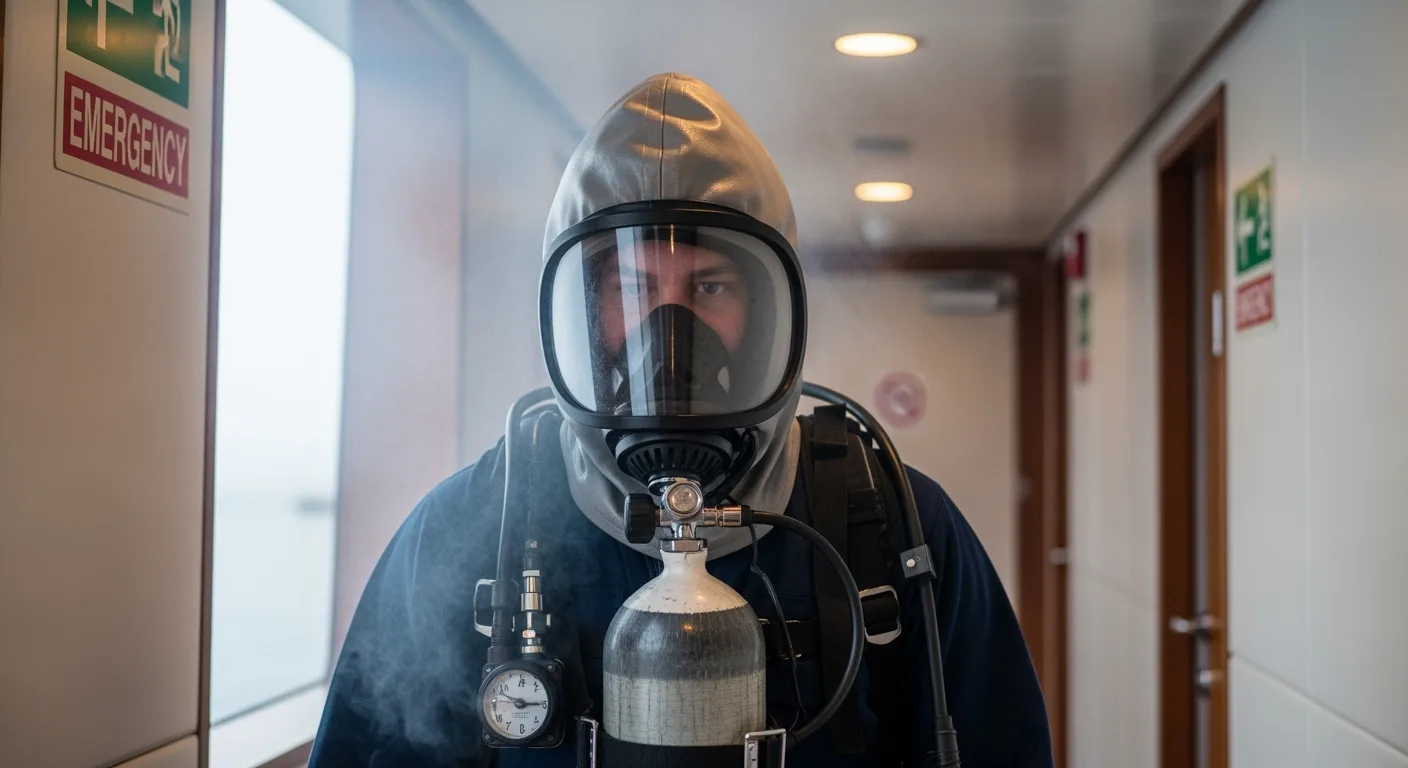
What the FSS Code requires of the device
The performance requirements sit in chapter 3 of the FSS Code, the code that SOLAS chapter II-2 relies on for fire safety equipment. An EEBD must:
- provide a service duration of at least 10 minutes;
- include a hood or full face piece that protects the eyes, nose and mouth during escape, made of flame-resistant material with a clear viewing window;
- be capable of being carried hands-free when not activated;
- be protected from the environment while stored;
- carry brief instructions or diagrams clearly printed on it, and be quick and easy to put on.
Each unit is also marked with its maintenance requirements, the manufacturer’s trademark and serial number, its shelf life with the date of manufacture, and the name of the approving authority. A unit kept for training must be clearly marked as such.
Ten minutes is a minimum. Manufacturers also offer units with longer rated durations, and some use a compressed air cylinder while others use an oxygen source. The figure that matters for a particular unit is the one in its approval and the manufacturer’s documentation.
EEBD and SCBA: the difference
An EEBD is designed for escape. Firefighting and entry into hazardous spaces require breathing apparatus specifically suited to those tasks.
| Feature | EEBD | SCBA in a fire-fighter’s outfit |
|---|---|---|
| Purpose | Escape from a hazardous atmosphere only | Firefighting and entry into hazardous spaces for which the apparatus is suited |
| FSS Code minimum | At least 10 minutes’ service | At least 1,200 litres of air for compressed air sets, or at least 30 minutes for other types |
An EEBD should never be used to go back into a smoke-filled space to search for someone.
Where EEBDs are carried
SOLAS regulation II-2/13 sets the carriage rules for ships to which that chapter applies. Every such ship carries at least two EEBDs within accommodation spaces. A passenger ship must have at least two in each main vertical zone; if she carries more than 36 passengers, two more are required in each zone. Regulation 13.3.4.5 excludes certain zones from these passenger-ship zone requirements: stairway enclosures forming individual main vertical zones, and zones at the fore or aft end without spaces in the categories specified by that regulation.
For machinery spaces, regulation II-2/13.4.3 does not give a number. EEBDs must be ready for use at easily visible places that can be reached quickly in a fire, with their location taking account of the layout of the space and the number of people normally working there.
IMO’s unified interpretation in MSC/Circ.1081 addresses machinery spaces where crew normally work or are routinely present. For category A spaces containing internal combustion machinery used for main propulsion, it recommends one EEBD in an engine control room inside the space, one in the workshop unless it has direct access to an escape way, and one on each deck or platform level near the ladder forming the second means of escape. The Administration may determine a different number or location based on the space’s layout, dimensions or normal manning. Other machinery spaces are addressed separately by the interpretation.
The number and location of machinery space devices are shown on the fire control plan. Spare units are also required, and flag administrations set or interpret how many.
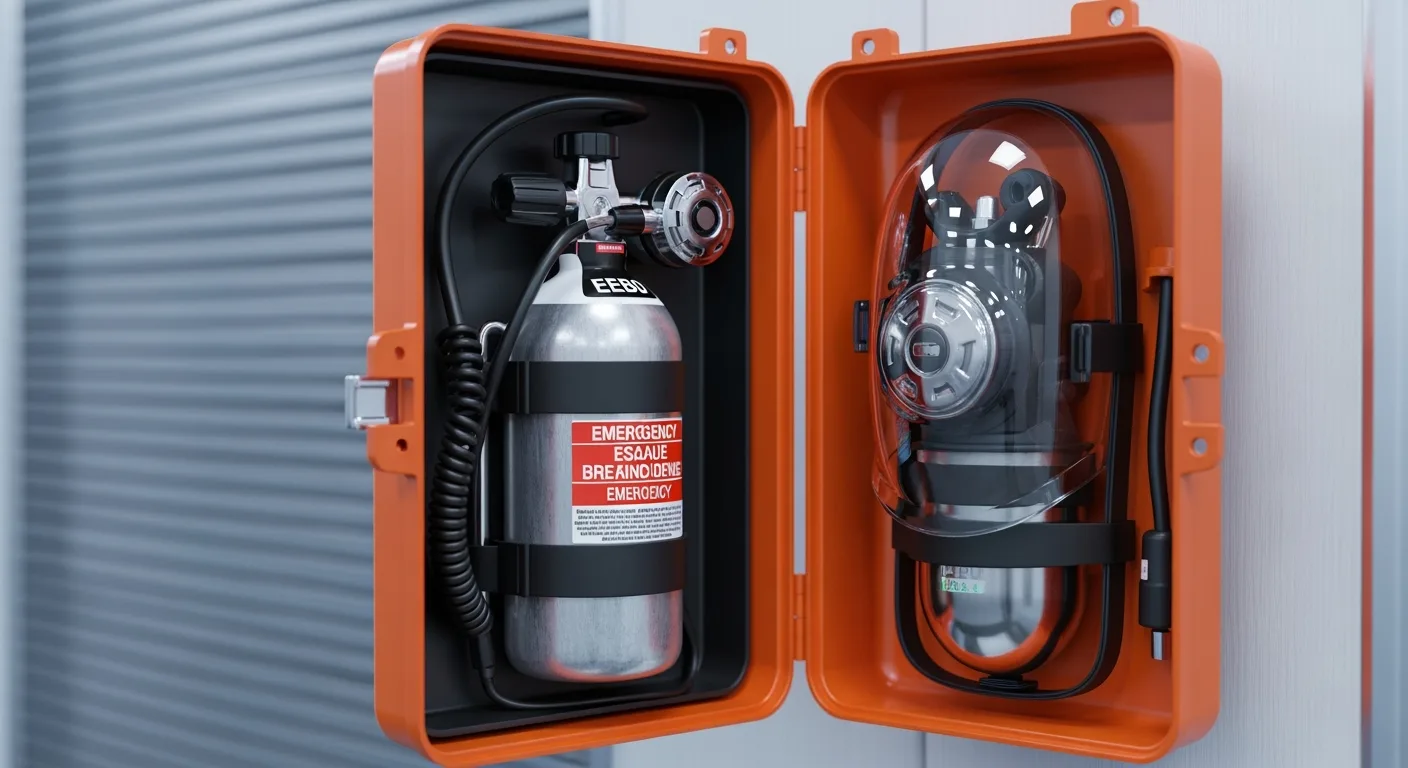
Which yachts must carry them
Applicability depends on how the yacht is registered and operated, not on her length alone. SOLAS chapter I excludes pleasure yachts not engaged in trade from the regulations, unless a regulation expressly provides otherwise. For EEBD carriage on a privately used pleasure yacht, her flag state‘s requirements therefore need to be checked.
The Red Ensign Group Yacht Code is one example of how this is handled for yachts. The following provisions are from the July 2024 edition, with Corrigenda no.1 incorporated in Part A. Under Part A’s transition provisions, some existing yachts may continue under earlier standards, so the edition applicable to the individual yacht must also be checked.
- Part A covers yachts of 24 metres and over in load line length (or, if built before 21 July 1968, of 150 GT and over) that are in commercial use for sport or pleasure, carry no cargo and carry no more than 12 passengers. Its EEBD section sits in chapter 14B, which applies to vessels of 500 GT and over. It requires at least two EEBDs within accommodation spaces, at least two in each main vertical zone, at least one spare, and units in machinery spaces placed and recorded on the fire control plan as SOLAS describes.
- Part B covers pleasure yachts on international voyages carrying more than 12 but not more than 36 passengers, with no more than 200 persons on board in total and no cargo, whether private or engaged in trade. It requires at least two EEBDs in each main vertical zone, spares on board and machinery space units to the satisfaction of the Administration.
For a yacht under 500 GT, or one registered with another flag, the answer comes from that flag’s code and the vessel’s survey records. Flag guidance also allows for more units than the minimum: Liberia’s Technical Letter 2017-01, for example, notes that the classification society may require additional EEBDs in accommodation spaces after reviewing the layout and operations.
Inspection, servicing and records
Maintenance follows the manufacturer’s instructions, but flag requirements differ in the detail. The Bahamas Maritime Authority’s Marine Notice 81 v1.1 requires, for ships within its SOLAS scope, inspection by a competent person at least annually and hydrostatic testing of EEBD cylinders at least every five years, or more frequently if the manufacturer requires it. The test exemption applies to small-capacity oxygen cartridge units whose manufacturer specifies a fixed service life without scheduled hydrostatic testing.
Liberia’s Technical Letter 2017-01 does not require periodic hydrostatic testing and expects units past the manufacturer’s stated service life to be discarded. Its requirement to follow the manufacturer’s servicing and maintenance instructions still applies. Both notices include EEBD inspection in the ship’s safety equipment arrangements, and the Bahamas requires the records to be kept on board.
Donning and activation differ between models, so crew learn them from the manufacturer’s instructions and onboard training rather than from a general description. Under the Bahamas notice, training is supported in one of two ways: a separate unit marked for training, or a means of restoring the unit used for training to full operating condition, such as recharging its cylinder.
EEBDs during a refit
Moving a workshop, enlarging an engine control room or changing an escape route can change where machinery space EEBDs should be stowed. If the EEBD arrangement changes, the fire control plan needs revising to match. Some flags attach a formal step to this: for ships within the scope of Marine Notice 81, the Bahamas requires a risk assessment when the number or location of machinery space EEBDs changes, with the outcome agreed with the Recognised Organisation that issues the ship’s statutory certificates.
Larger projects can change which rules apply. Under REG Part A, areas of a yacht that undergo alterations which substantially change her dimensions or substantially extend her service life are treated as new construction from the date the work begins, and a change that crosses a regulatory threshold such as 500 GT brings in the provisions for a new vessel of that size. Which areas and provisions are affected is settled with the Administration, which expects detailed proposals early. A refit specification that touches machinery space layout or extends the yacht should therefore include EEBD positions within its fire safety scope.
Frequently Asked Questions: EEBD
What is the full form of EEBD?
EEBD stands for Emergency Escape Breathing Device. It is an approved breathing device designed to help a person escape from a hazardous atmosphere.
What is the meaning of EEBD on a ship?
On a ship, an EEBD is an escape-only breathing device that supplies air or oxygen while the wearer evacuates a compartment affected by smoke, toxic gases or another hazardous atmosphere. It is not designed for firefighting, rescue entry or work in oxygen-deficient enclosed spaces.
How do you use an EEBD?
Follow the instructions printed on the specific device. Depending on the model, this may involve opening its protective case, activating the breathing supply and fitting the hood or full face piece before evacuating immediately to a safe area. Activation and donning procedures vary between manufacturers, so crew should practise with an appropriate training unit. An EEBD must never be used for firefighting or re-entering a hazardous compartment.
How long does an EEBD last? (EEBD duration)
The FSS Code requires a minimum service duration of 10 minutes. Some approved EEBD models provide longer rated durations. The actual available breathing time depends on the device’s design, approval and operating conditions. Always check the manufacturer’s stated duration and do not assume that every EEBD provides 10 to 15 minutes of protection.
What is the difference between EEBD and SCBA?
An EEBD is intended only for escaping from a hazardous atmosphere, while an SCBA (Self-Contained Breathing Apparatus) suitable for firefighting allows trained personnel to enter and operate in hazardous spaces. Under the FSS Code, an EEBD must provide at least 10 minutes of service, while firefighting breathing apparatus must meet separate capacity or duration requirements, including at least 1,200 litres of air for compressed-air sets or at least 30 minutes for other types.
Where should EEBDs be located on a yacht?
EEBDs should be stored in clearly identifiable, readily accessible locations where they can be reached quickly during an emergency. Depending on the applicable rules, these may include accommodation spaces, engine control rooms, workshops and machinery space escape routes. For yachts subject to SOLAS chapter II-2, the number and placement depend on the vessel’s layout and relevant carriage requirements. Machinery space EEBD positions must be recorded on the fire control plan. Private yachts outside those requirements must follow their flag’s applicable safety code and approved arrangements.
Can an EEBD be used to help someone else escape?
An EEBD is designed to provide breathing protection for one wearer at a time. It cannot supply breathing air to two people simultaneously and must not be used for rescue entry into a hazardous compartment. A person wearing an EEBD may help guide another person during an evacuation if it is safe to do so, but anyone who needs respiratory protection must have their own suitable device. Entry into a hazardous space for rescue requires appropriately equipped and trained personnel.
How often do EEBDs need to be replaced or serviced?
EEBD servicing and replacement intervals depend on the manufacturer’s instructions, the device’s approved service life and the flag Administration’s requirements. There is no universal 10-to-15-year replacement interval for every model. For example, the Bahamas Maritime Authority requires competent-person inspections at least annually and generally requires hydrostatic testing of applicable EEBD cylinders at least every five years. Liberia does not require periodic hydrostatic testing under Technical Letter 2017-01. Expired, damaged or unserviceable units must be removed from operational use and replaced or serviced as permitted by the manufacturer.
Can anyone use an EEBD, or do you need special training?
EEBDs are designed for rapid donning in an emergency, but familiarisation and onboard training are important. Crew should know where the devices are stored, how their particular model is activated and fitted, and how to follow the escape route. Training must reflect the manufacturer’s instructions. Where required, dedicated EEBD training units should be clearly marked and kept separate from operational equipment.
Are there visual indicators to show if an EEBD is still functional?
Some EEBD models have pressure gauges, status indicators, seals or other readiness checks, but these features are not identical across all devices. Certain chemical oxygen units do not use a conventional compressed-air pressure gauge. Check the manufacturer’s specified inspection indicators, packaging condition, expiry date and maintenance records. Any indication of damage, leakage, expired service life or loss of readiness should be investigated before the device is returned to service.
Can an EEBD be repacked or reused after a false alarm or short use?
Not all EEBDs are single-use devices. Whether an activated unit can be restored depends on its approved design and the manufacturer’s servicing instructions. Some compressed-air models may be recharged and returned to service following the required checks, while sealed chemical oxygen units may need replacement after activation. An activated EEBD must not simply be repacked and returned to its storage position without completing the approved restoration procedure. The Bahamas Maritime Authority expressly recognises recharging arrangements for suitable EEBDs used during training.