

Glossary Term
COLREG
COLREG (International Regulations for Preventing Collisions at Sea) is a treaty-level rule set that tells vessels how to avoid each other, what lights and shapes to show, which sound signals to make, and how to behave in narrow channels and traffic schemes. It applies to all vessels on the high seas and connected waters, from tenders to superyachts and commercial craft. Administrations incorporate it into national law, which is why many mariners also see the rules published in domestic codes. If you hear the term IRPCS, that is simply another name for the same regulations used in some jurisdictions.
The core seamanship rules every yacht should live by
Keep a lookout, always
Rule 5 requires a proper lookout by sight and hearing, using all available means. In practice, that means eyes out of the wheelhouse, listening for signals, and making systematic use of radar and AIS where fitted.
Safe speed is situational
Rule 6 asks you to proceed at a speed that allows effective avoidance and stopping, taking visibility, traffic density, sea state, and background lighting into account. If fog rolls in or you enter a dense fishing fleet, reduce speed and be ready to maneuver.
Assess risk of collision deliberately
Rule 7 calls for early use of plotting tools and, if fitted, radar long range scanning. If the bearing of another vessel does not appreciably change, assume risk exists and act early.
These three rules underpin everything else. They also explain why a yacht that “technically” stands on may still slow or alter to avoid doubt when conditions deteriorate.
Give-way and stand-on, without the myths
COLREG does not grant anyone absolute right of way. It assigns responsibilities to reduce ambiguity, then expects both vessels to avoid a collision if the other fails to act.
Overtaking, Rule 13
If you are coming up from more than 22.5 degrees abaft another vessel’s beam, you are overtaking and must keep clear. Once overtaking, you remain the give-way vessel until past and clear, even if relative positions shift.
Head-on, Rule 14
Two power-driven vessels meeting head-on must both alter course to starboard to pass port to port. When in doubt whether it is head-on, assume it is and act accordingly.
Crossing, Rule 15
Power-driven vessels crossing with risk of collision, the vessel that has the other on her starboard side keeps clear and avoids crossing ahead if possible.
Responsibilities between vessels, Rule 18
Power-driven gives way to sailing, vessels engaged in fishing, restricted in ability to maneuver, and not under command. All vessels should avoid impeding a vessel constrained by her draft, and that vessel navigates with particular caution.
For bridges that rely heavily on electronics, link your radar and AIS thoughtfully and use them to confirm, not to assume. A plotted CPA that suddenly degrades is your cue to make a bold, early alteration that is easy to read by the other vessel.
Lights, shapes, and signals make your intentions legible
Part C of COLREG details what lights and day shapes a vessel must show, and Part D covers sound signals. For yachts, getting these right is not cosmetic, it is communication that lets others classify you instantly. Examples include an anchored yacht showing an all round white at night, a vessel constrained by draft displaying three all round red lights in a vertical line, or a yacht engaged in towing showing additional lights and shapes per its length and tow. The technical standards for intensity and sectors are set so other vessels can interpret you at range.
How COLREG meets modern bridge systems
COLREG anticipates the tools you carry. Rule 7 explicitly instructs proper use of radar if fitted, including long range scanning and systematic plotting. Rule 19 adds conduct for restricted visibility, for example engines ready for immediate maneuver and avoiding port alterations for a vessel forward of the beam when detected by radar alone. An ECDIS or plotter overlay does not replace these judgments, it supports them.
If your yacht is commercially operated, SOLAS requires a suite of navigation equipment and procedures that complement COLREG, from carriage of radar to record keeping. Managers should align standing orders, watch schedules, and bridge checklists so that COLREG compliance is baked into routine, not left to memory.
Practical vignettes that change outcomes
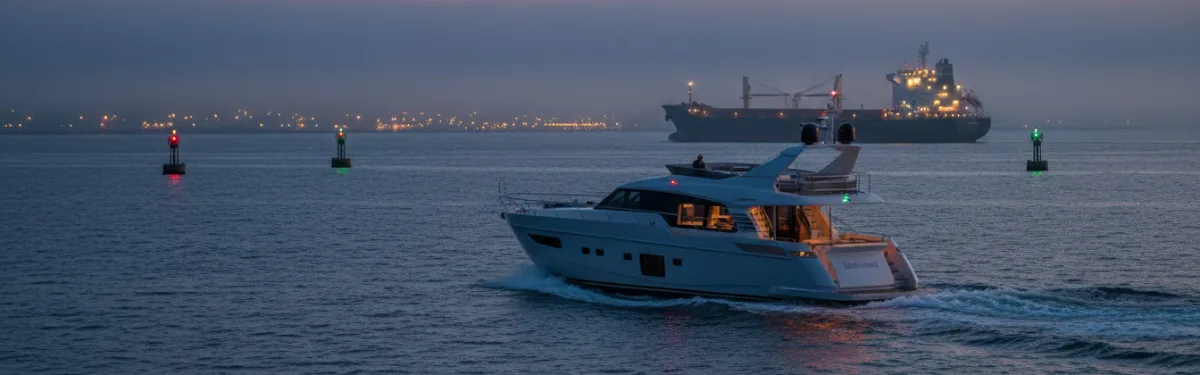
Night approach in partial fog
Visibility drops to half a mile, traffic density increases near a harbor entrance. Under Rules 5 and 6 you reduce to a speed that allows stopping within visible range, post an extra lookout on the bridge wing, and set a guard zone on radar for early warning. You are now legally compliant and practically safer.
A fast RIB appears abaft your beam
Bearing drift is minimal, range is closing. Even if your course feels constant, you are being overtaken under Rule 13, so you maintain course and speed while the RIB keeps clear. If the RIB fails to act, Rule 17 allows you to maneuver to avoid collision.
Crossing a traffic lane
Rule 10 for traffic separation schemes requires crossing at right angles and not impeding traffic in the lanes. A small course change that looks neat on the plotter can be noncompliant if it causes a large ship to alter. Plan early and commit to a legible maneuver.
Implications for owners, crew, and managers
Owners and guests
A yacht culture that respects lookout, safe speed, and early action makes night passages calmer and shore arrivals uneventful.
Captains and officers
Write standing orders that reference the relevant rules directly, for example when to declare restricted visibility, how to use radar guard zones, and what constitutes “early and substantial” action. Train for ambiguity, not just textbook cases.
Management companies
Align SMS procedures with COLREG language, then audit real behaviors at sea. Drills during a scheduled sea trial after a refit are a natural moment to verify radar usage, sound signals, lights, and bridge resource management.
Common confusions, quickly cleared up
- “Right of way” is a misleading phrase at sea. The stand-on vessel still has duties, and both vessels must avoid a collision if the other does not act.
- Sailing vs power. A sailing yacht becomes power-driven when the engine is used, even with sails set, which changes who must keep clear under Rule 18.
- When in doubt. For head-on uncertainty, treat it as head-on and alter to starboard in good time. Doubt is a trigger, not an excuse to wait.
COLREG is not just an exam subject, it is a living framework that keeps yachts separated when visibility is poor, closing speeds are high, and intentions are unclear. If you make lookout, safe speed, and early action your crew’s reflex, then support those habits with clear lights, legible maneuvers, and smart use of marine technology, you convert abstract rules into predictable, courteous seamanship. That predictability is what lets mixed traffic share tight waters with confidence.
COLREG FAQ For Yachts
Do the COLREGs apply to private yachts and tenders in coastal waters?
Yes. COLREG applies to all vessels on the high seas and in connected navigable waters, which includes private yachts, RIBs, and tenders. Local harbor bylaws may supplement the rules, but they do not replace them.
Who has right of way, a sailboat or a powerboat?
COLREG avoids the phrase “right of way.” When crossing, a power-driven vessel usually keeps clear of a sailing vessel under Rule 18, but both craft must avoid a collision if the other fails to act. If a sailing yacht is using its engine, it is considered power-driven for the purposes of the rules.
What does “proper lookout” actually mean at night or in fog?
It means continuous observation by sight and hearing, supported by all available aids. Post extra lookouts when visibility drops, use long-range scans on radar if fitted, and keep bridge audio cues and guard zones active.
How fast is “safe speed” for a yacht?
There is no fixed number. Safe speed is whatever allows you to take effective action and stop within the distance visible ahead, considering visibility, traffic density, sea state, background lighting, and your yacht’s handling.
Head-on or crossing, how do I tell the difference quickly?
If you see both sidelights or a constant bearing with closing range ahead, treat it as head-on and alter to starboard early. If another power-driven vessel is on your starboard side with risk of collision, you are the give-way vessel in a crossing situation.
How big should my avoiding action be?
Make it early and substantial so it is obvious by eye and on instruments. A bold course alteration to starboard or a clear speed change is easier for others to interpret than small, frequent tweaks.
Does COLREG require me to have radar or AIS on a yacht?
COLREG does not mandate specific equipment, but if radar or AIS is fitted, you must use it properly to assess risk and avoid collisions. Carriage requirements for some yachts may come from SOLAS or flag state rules, which is a separate compliance topic.
What should I do in restricted visibility if I only see a target on radar?
Follow Rule 19. Keep engines ready for immediate maneuver, avoid sweeping port alterations for vessels forward of the beam, and use plotting or ARPA to evaluate CPA before making a clear, decisive move.
Overtaking rules confuse me. When am I definitely overtaking?
If you are coming from more than 22.5 degrees abaft the other vessel’s beam, you are overtaking and must keep clear until you are past and well clear. If in doubt, assume you are overtaking.
When do I need to use the horn or whistle?
Use maneuvering signals when vessels are in sight of one another and close enough that signals aid clarity. One short blast indicates altering to starboard, two to port, and three means operating astern propulsion; prolonged blasts and additional patterns apply in restricted visibility.
How should a yacht cross a traffic separation scheme safely?
Plan early, cross at right angles to the traffic lanes, and do not impede vessels using the lane. Maintain a steady, legible course and speed so large ships can predict your movement.
Can I rely on autopilot and still be compliant?
Yes, but only with an active human lookout. Autopilot is a steering aid, not a decision maker, and the watchkeeper remains fully responsible for collision avoidance.