

Glossary Term
ARPA
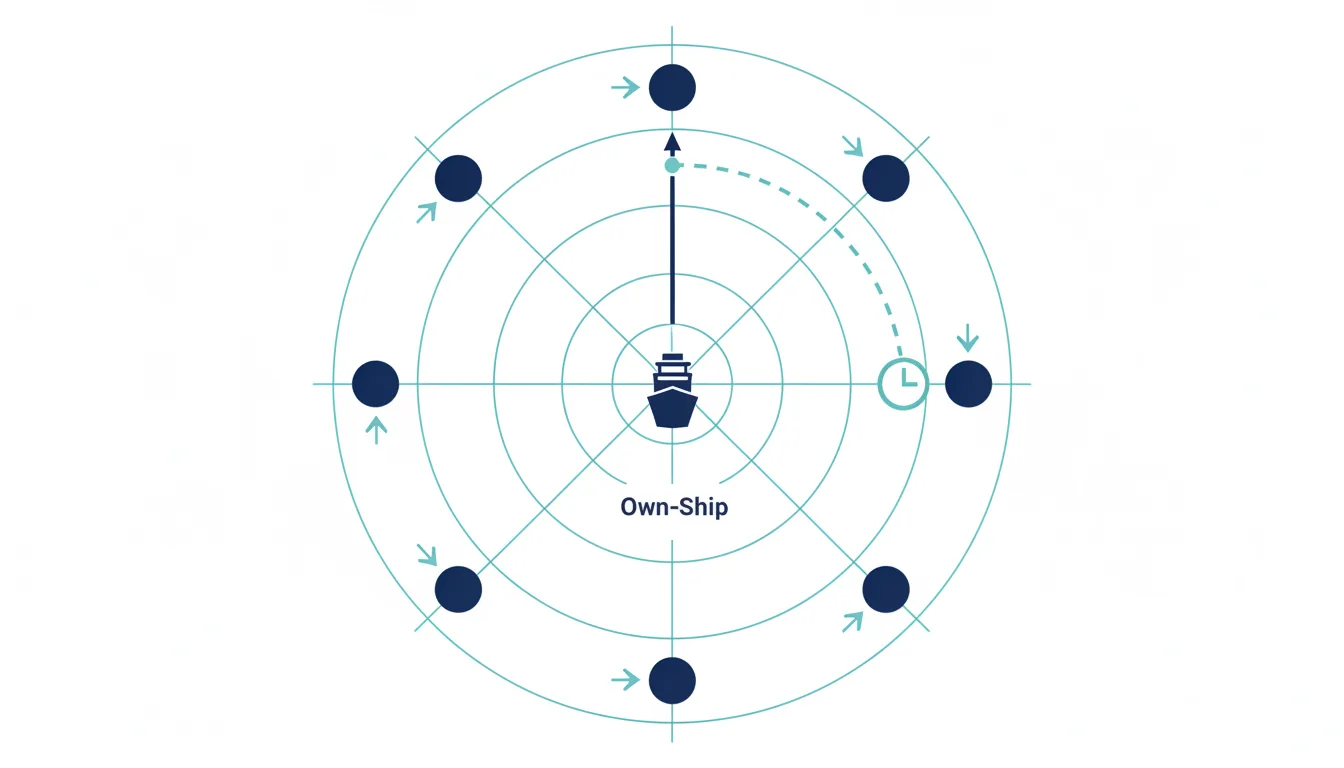
ARPA (Automatic Radar Plotting Aid) is a radar processing function that acquires radar targets, tracks their motion, and calculates key collision metrics. Core outputs include closest point of approach (CPA) and time to closest point of approach (TCPA), along with target course and speed, presented as vectors in either true or relative motion. International performance standards define what a compliant ARPA must do on the display, how many targets it can track, and how the data should be presented for collision assessment.
How ARPA works, in plain terms
ARPA takes the raw returns from the antenna and correlates them over time to form a track for each acquired target. The system uses your vessel’s inputs, typically gyro heading, speed log or GPS, to stabilize plots and compute relative movement. With those inputs, ARPA can display true or relative vectors, run trial maneuvers that preview the effect of a course or speed change, and raise CPA or TCPA alarms when thresholds are crossed. The aim is simple, reduce workload while improving the speed and accuracy of situation evaluation.
Acquisition and tracking
Most sets offer both manual and automatic acquisition. Manual acquisition lets the operator select specific returns for tracking. Automatic acquisition locks on to new targets entering a guard zone or meeting defined criteria, then promotes them to full tracks once motion is confirmed. Standards require a consistent set of range scales and clear indications of a target’s status so the watchkeeper can judge confidence at a glance.
What the numbers mean
CPA estimates how close another track will approach if both vessels maintain current motion, and TCPA estimates when that minimum separation will occur. These are decision aids, not guarantees. Sensor errors, sea clutter, course changes by other traffic, or incorrect stabilization can degrade accuracy, which is why ARPA is paired with professional lookout, COLREGs, and cross checking on the bridge.
Why ARPA matters on yachts
Risk clarity for the watch
ARPA gives immediate visibility of which echoes deserve attention and which do not, so scarce attention is spent on the right targets. CPA and TCPA alarms reduce the chance of late action during congested transits.
Professional standards and audits
The IMO sets performance rules for shipborne radar and ARPA, and many yacht programs adopt similar expectations even when not strictly SOLAS-class. Aligning equipment and procedures to those norms supports safer operations and easier third-party inspections.
System integration
ARPA tracks displayed alongside AIS targets, ECDIS overlays, and radar video create a consistent picture for the bridge team. Integration is valuable, but each sensor has different error characteristics, so crews should understand what ARPA is computing and what AIS is broadcasting before acting.

ARPA, AIS, and good judgment
It is tempting to lean on AIS data for bearings, rates, and identities. Formal guidance recognizes AIS as an additional source that can assist collision avoidance, but it does not replace radar and ARPA derived information. Reasons are practical, AIS depends on the other vessel transmitting correct data and can be delayed or incomplete, while ARPA computes motion from your own sensors and the echo you are actually seeing. The best practice is to use AIS to enrich identification and to validate, not to substitute for, ARPA plots when making COLREGs decisions.
Keys to reliable ARPA performance on a yacht
Clean inputs
Accurate gyro heading, a healthy speed input, and solid GPS data are prerequisites. If one input is degraded, stabilization and vector accuracy suffer, which cascades into misleading CPA or TCPA. Standards explicitly consider sensor errors in ARPA performance scenarios, a reminder to verify inputs during bridge checks.
Thoughtful configuration
Choose vector mode and length that match your operating picture, set CPA and TCPA thresholds appropriate to your yacht’s maneuvering profile, and use guard zones that reflect local traffic patterns. Trial maneuvers are most useful when the display scale and vector time give enough foresight without clutter.
Planned maintenance
Keep arrays, waveguides, and connectors in good order, and verify warm-up and standby behavior against manufacturer specs and recognized performance guidelines. A periodic check that ARPA acquires, promotes, and holds tracks across several range scales belongs in your tests and surveying regime.
Training and procedures
Specify who acquires targets, who manages CPA alarms, and how handovers are conducted when switching range scales or vector modes. Document the cross check with visual lookout, AIS, and ECDIS so teams do not over-trust a single aid.
Clarifying adjacent terms you will encounter
You may see ATA, Automatic Tracking Aid, on some sets. ATA offers simplified tracking functions compared to full ARPA, with fewer features and typically fewer simultaneous targets, but the operational intent is similar, reduce manual plotting effort while providing vectors and CPA data on acquired targets. Your bridge procedures should reflect what your specific installation can and cannot do.
Where ARPA fits in refit and management planning
For management companies scheduling upgrades or yard periods, ARPA capability should be reviewed alongside antenna condition, display integration, and training. If you are planning a refit, verify the radar’s compliance baseline against modern performance standards and confirm that sensor inputs, alarms, and trial maneuver functions are fully available after any electrical or mast work. Integrating ARPA with AIS targets and route layers on ECDIS can streamline watchkeeping when done with clean cabling and power segregation.
ARPA turns the moving pieces around your yacht into a live, testable plan. It does the math quickly, but it also exposes the limits of your inputs and assumptions, which is exactly what a good aid should do. Treat ARPA as the bridge team’s analytical partner, configure it deliberately, and let its clear CPA, TCPA, and vector picture anchor confident decisions at sea.
ARPA FAQs
How should I set CPA and TCPA alarms on my yacht’s ARPA?
Choose values that reflect your yacht’s stopping distance, maneuverability, and typical traffic density. Many crews start conservative, then tighten thresholds after a few watches to reduce nuisance alarms. Revisit the settings when conditions change, such as restricted visibility or narrow channels.
Why does CPA or TCPA keep jumping even though neither vessel changed course?
Unstable inputs, like erratic speed-through-water or a drifting heading source, can make vectors wobble. Heavy sea clutter, rain clutter, or a weak echo can also confuse the tracker until it promotes to a firm track. Check sensor health, adjust anti-clutter controls, and give the ARPA a little time to converge.
Should I use true vectors or relative vectors for collision assessment?
Use true vectors to understand how targets move over the ground, which helps with traffic patterns and current set. Use relative vectors when you care primarily about the closing situation with your own yacht. Many bridges toggle between the two, depending on whether they are planning or actively avoiding.
What inputs does ARPA need to be reliable, and which one fails most often?
It relies on clean gyro heading, speed, and often GPS for stabilization and velocity calculations. Weak or intermittent heading is the most common culprit for strange plots, since every bearing depends on it. If a source is suspect, switch to a backup or flag the display as unstabilized.
Can ARPA work if GPS drops out temporarily?
Yes, but accuracy and features can degrade, especially for true-motion displays and ground-referenced vectors. If you have a speed log and stable heading, relative tracking can still be useful. Mark the loss in the log and be extra cautious until all sensors are back.
How do guard zones relate to automatic target acquisition?
A guard zone is a watch ring that raises attention when new echoes appear inside it. Automatic acquisition can be tied to that zone so the set starts tracking without manual selection. Keep the zone practical, wide enough to catch inbound traffic but not so wide that it fills your tracker with distant clutter.
What is a trial maneuver and when should I use it?
It is a safe preview of a proposed course or speed change drawn on the ARPA picture. Use it before altering, so you can see the new CPA and TCPA and confirm the action will open the closest target. It is especially handy in multi-target situations where a simple turn might solve one risk but create another.
ARPA and AIS both show vectors, which one should I trust for collision decisions?
Treat ARPA as the primary motion picture because it computes from echoes you are detecting. Use AIS to confirm identity, intentions, and to cross check speeds or headings. If they diverge, resolve the reason before acting, since AIS can be delayed or incorrectly configured.
Why does my ARPA drop tracks when I change range scale?
Some sets reduce track persistence at very short or very long ranges to manage processing load and display clarity. If you are hunting for a specific target, avoid frequent range hopping and give the tracker time to re-confirm motion. Check your manual for settings that retain tracks across scales.
Is ARPA mandatory on all yachts?
Not universally. Requirements depend on size, area of operation, and flag or class rules. Even when not required, having ARPA aligned with recognized performance standards is a strong safety upgrade and simplifies audits and training.
What is the practical difference between ARPA and ATA on a radar?
ARPA is the fuller capability with advanced features such as more simultaneous tracks, trial maneuvers, and robust automatic acquisition logic. ATA offers core tracking and CPA/TCPA on fewer targets, which can be sufficient for smaller yachts with simpler traffic pictures. Build procedures around the actual features your set supports.
How often should ARPA be tested or calibrated?
Include a short functional test in pre-departure checks and a deeper verification during yard periods. Confirm acquisition, promotion, vector stability, and alarm behavior on multiple ranges. After any mast, power, or sensor work, run a dedicated validation before returning to high-density waters.
Can heavy rain or sea state make ARPA unreliable?
Yes, excessive rain clutter and breaking seas can mask or reshape echoes, delaying promotion to a firm track. Use rain and sea clutter controls to clean the picture, narrow the sector if appropriate, and treat early CPA/TCPA readings as provisional until the track stabilizes.
What’s the smartest first step if an ARPA track looks wrong?
Cross check with visual bearings and AIS, then verify your own inputs. A quick sanity check of heading alignment, speed source, and vector mode often reveals the cause. If in doubt, revert to manual acquisition on the suspect target and reassess before altering course.
Sources
IMO Resolution A.823(19), Performance standards for Automatic Radar Plotting Aids (ARPA)
IMO Resolution MSC.192(79), Adoption of the revised performance standards for radar equipment
CCGA Pacific, Chapter 5, Automatic Radar Plotting Aids, training manual
IALA Guideline 1082, An overview of AIS, limitations and use