

Glossary Term
VHF
Very High Frequency marine radio used for short-range ship-to-ship and ship-to-shore communications, including DSC distress and calling. VHF (Very High Frequency) refers to radio frequencies from 30 to 300 MHz, and the maritime service occupies a dedicated slice between 156 and 174 MHz. Within this band, equipment is channelized, standardized internationally, and optimized for short, prompt transmissions that are easy to copy over engine noise and weather. The result is a communication system that is simple to learn, robust in coastal conditions, and interoperable across flags and ports.For yachts, marine VHF equipment enables ship to ship and ship to shore calling, routine traffic, safety coordination, and regulated distress procedures. Two channels define the core: Channel 16 at 156.8 MHz for distress, safety, and calling, and Channel 70 at 156.525 MHz reserved exclusively for DSC (Digital Selective Calling) digital alerts and selective calling. The division keeps critical signaling separate from voice so important traffic can be handled without clutter.
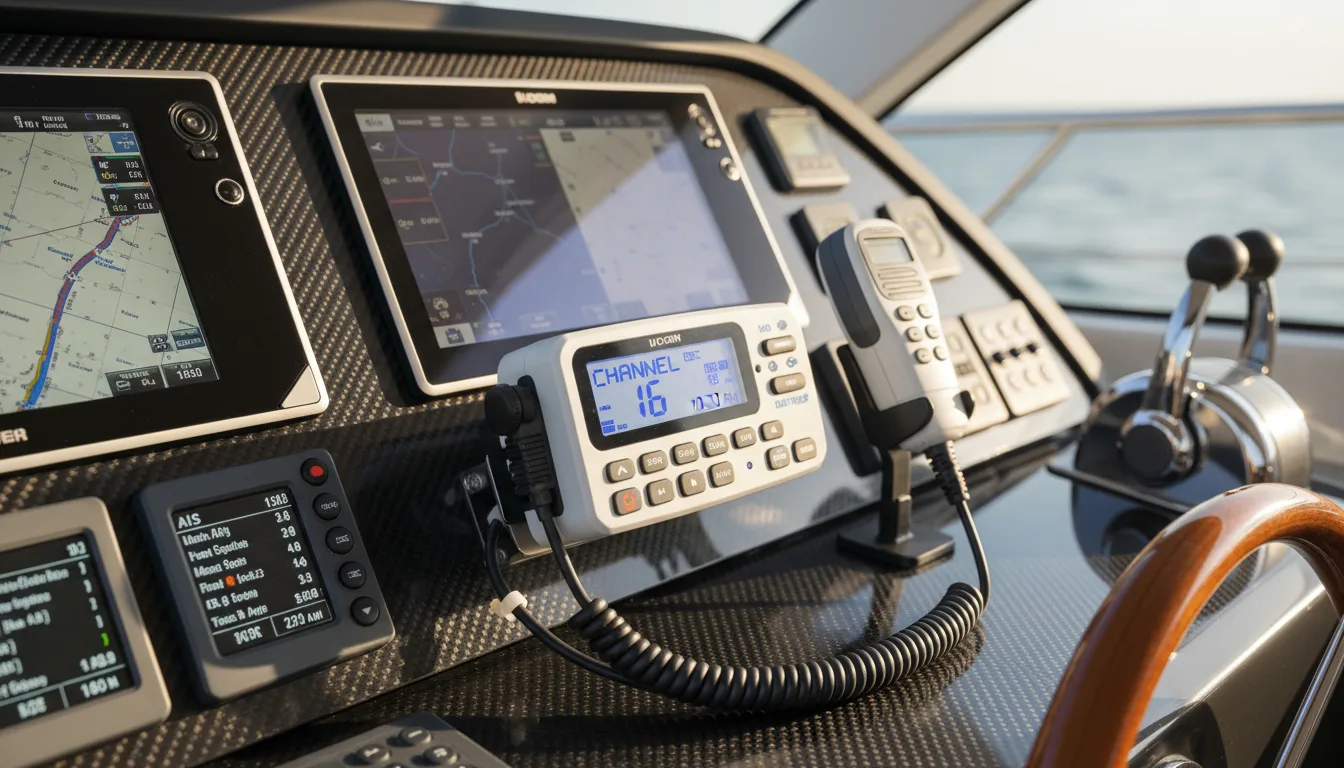
A yacht’s VHF fit is usually a fixed-mount VHF at the main helm, often with a second station, and one or more handheld VHF sets for deck work and tender operations. Power levels and antenna height determine coverage, and the system relies on line of sight propagation. Think in terms of a few tens of nautical miles in typical installations, with greater reach to high coastal sites and shorter reach when antennas sit low. This behavior rewards good antenna placement, quality coax runs, clean connectors, and periodic checks in the planned maintenance system.
Modern sets integrate DSC. With DSC, the radio can originate and receive digitally formatted distress, urgency, safety, and routine calls. Each unit is programmed with an MMSI that identifies the vessel, which lets shore stations or other vessels “ring” you directly and lets automated alerts carry identification even if voice is unavailable. Entering the correct MMSI, and keeping it aligned to the vessel’s registration, is a basic compliance and safety task.
Channels and special functions you should actually know
Maritime channels are preassigned to specific functions by the ITU Radio Regulations. The essentials for yachts are straightforward to memorize and build into procedures.
Channel 16, distress, safety, and calling. Many administrations require a listening watch when not actively communicating on another channel.
Channel 70, DSC only, no voice. Your radio should keep a continuous DSC watch.
Bridge-to-bridge and port operations channels vary by coast and VTS scheme, so the passage plan should include local working channels and power limits for close-quarters communication.
Two adjacent VHF slots also matter even if you never touch them. AIS broadcasts operate on 161.975 MHz and 162.025 MHz, separate from voice and DSC, which is why collision-avoidance data flows while the radio is busy with other traffic. If AIS is part of your fit, keep its cabling and GPS inputs healthy, since integrity here affects situational awareness on your ECDIS and radar displays.
If you are formalizing your bridge procedures, it helps to read VHF and AIS guidance together. The UK MCA highlights appropriate VHF and AIS use for watchkeeping and collision risk decisions, a useful companion to equipment manuals and local VTS instructions.
Where VHF fits within GMDSS and compliance
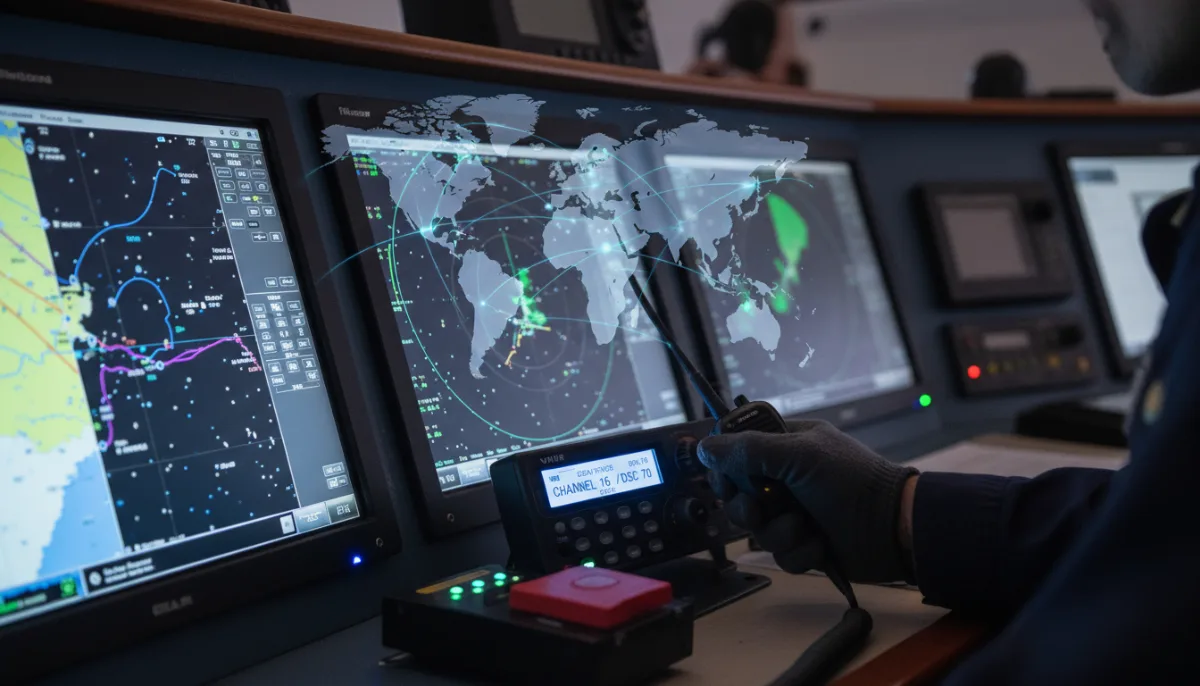
Within GMDSS the VHF installation is the coastal cornerstone. SOLAS-class ships must be able to transmit DSC on Channel 70, and conduct radiotelephony on Channels 16, 13, and 6 as applicable. Even when your yacht is not a SOLAS ship, aligning with those practices supports professional watchkeeping, clean drills, and easier master-pilot exchanges.
Watchkeeping rules reflect that split between digital and voice. Ships keep a continuous watch on DSC Channel 70, and many administrations also require or recommend maintaining a voice watch on Channel 16 when practical. Your Safety Management System should specify who watches which function at sea and in port, and how you log the changeover when shifting to working channels.
If you manage licensing, two administrative elements recur. First, ensure the vessel holds the appropriate ship radio licence and that any DSC equipment is programmed with the correct MMSI. Second, update the licence and MMSI records when equipment changes or ownership transfers, since the identifier ties your distress alert to the right contact data. National regulators, for example Ofcom in the UK and the FCC in the US, publish clear guidance on these points.
Choosing, installing, and maintaining the system
From a refit or new-build perspective, VHF reliability is driven by a few controllable decisions.
Antenna system. Prioritize masthead height where feasible, select a marine-tuned vertical whip, route low-loss coax with gentle bends, and keep terminations dry and supported. These choices maximize the line-of-sight horizon and reduce attenuation.
Power and integration. Fixed sets commonly operate at up to 25 W for routine working range, with selectable low power for close-quarters traffic. Integrate GPS to the VHF so DSC distress alerts carry position automatically.
Handhelds. Handheld VHF units are invaluable on deck and in the tender. Treat their chargers, spare batteries, and IP ratings as consumables in your maintenance planning, and include them in abandon-ship communication contingencies.
Procedures. Standardize radio checks, microphone discipline, and a short list of working channels for your areas of operation. Document how Channel 16 calling hands off to designated working channels to keep 16 clear.
If you are formalizing equipment alongside other bridge systems, it can be helpful to cross reference your policies on GMDSS operations, AIS use, and electronic navigation on ECDIS.
Clarifying adjacent technologies, briefly
VHF is intentionally coastal and tactical. It contrasts with MF/HF radio, which supports longer range skywave paths, and with satellite services such as VSAT, which provide broadband data beyond the horizon. For collision avoidance data, VHF carries AIS on its own channels, which complements, not replaces, radar and visual lookout in your bridge resource management. Align equipment choices with the yacht’s operating profile, the expected seas and ranges, and your manning model.
Why VHF matters for owners, crew, and managers
Owners and managers see VHF as low cost risk reduction. The parts are affordable, the procedures are teachable, and the payoff is continuous access to coastal authorities and nearby traffic. Crew value VHF for the same reasons, plus speed, clarity, and immediate escalation via DSC if conditions deteriorate. When you plan the next survey window or refit, treat VHF antennas, cabling, and configuration as safety-critical items to be inspected, tested, and documented alongside navigation and communication checks.
VHF works so well that it can fade into the background. Do not let it. Define the channels you will use, test the DSC path and MMSI data, verify the antenna system, and make VHF watchkeeping part of every passage plan. Do that consistently, and VHF will continue to be your quiet, everyday lifeline.
VHF FAQs
How far does marine VHF reach from a yacht?
VHF is line-of-sight. A quick rule of thumb is range in nautical miles ≈ 1.23 × (√antenna height of your yacht in meters + √the other station’s height). Taller antennas, clean coax, and correct power settings extend reliable coverage. Hills, masts, and heavy precipitation can shorten it.
Do I still need to listen to Channel 16 if my set watches Channel 70 automatically?
Yes, keep a practical voice watch on 16 while your radio maintains the DSC watch on 70. Many administrations expect a voice watch when not communicating elsewhere. Your Safety Management System should spell out who monitors what and when.
Fixed VHF or handheld, which should I rely on?
Use both for different jobs. Fixed units with masthead antennas and higher power handle primary ship-to-shore traffic, while handhelds shine for deck work, tender operations, and as a ready backup if the main set or power bus is unavailable.
What is an MMSI and why does it matter?
An MMSI is your vessel’s unique digital identity. It lets DSC calls carry your details automatically and enables selective calling. If the MMSI is wrong or unregistered, alerts can be misrouted and coast stations may not link your call to the right contact information.
How do I test DSC without triggering a false distress?
Use your radio’s DSC “test call” function to a coast station that accepts tests, or arrange an individual routine DSC test with another vessel. Never press the distress button during checks. Confirm the set has valid GPS input so test acknowledgments show a position.
Best antenna placement and cabling for strong VHF performance?
Mount a marine-tuned vertical whip as high and as clear as possible. Keep coax runs short, use low-loss cable, avoid tight bends, and seal connectors. Separate VHF and AIS antennas adequately or use a certified splitter that preserves both services.
Can VHF and AIS interfere with each other?
They occupy nearby frequencies but are designed to coexist. Problems usually come from poor cabling, bad splitters, or shared antennas without proper filtering. Maintain correct GPS feeds to the AIS transceiver, check SWR, and inspect connectors for corrosion.
Do I need a licence or operator certificate to use marine VHF?
Most flags require a ship radio licence for the installation and an operator certificate for at least one responsible crewmember. Handhelds are typically covered under the same licence. Check your flag state rules before programming the MMSI or purchasing equipment.
Why do others say my transmission is faint even though I hear them well?
Common culprits are low power selection, water-logged or corroded connectors, a damaged antenna, mic gain set too low, or an incorrect channel plan setting. Verify high/low power, inspect the antenna system, and confirm your radio is set to the correct international channel scheme.
Is marine VHF private or encrypted?
VHF is open and easily monitored. Assume anything you say can be heard locally, so keep messages short and professional and avoid sensitive information. For privacy or business discussions, use appropriate non-safety channels or alternative communications that fit your compliance rules.
What power setting should I use, 1 W or 25 W?
Use low power for close-quarters work to reduce interference and keep Channel 16 clear. Switch to high power when you need distance or you are calling shore stations. Some channels have power limits or special purposes, so follow local channel plans.
Can I connect my VHF to other bridge systems?
Yes, integrate GPS and network data via NMEA 0183 or NMEA 2000 where supported. This enables position-included DSC alerts, call logging on multifunction displays, and cleaner workflow with ECDIS or chart plotters. Verify proper galvanic isolation to avoid noise.
How often should I service VHF equipment?
Include the radio, antenna, and cabling in your planned maintenance. Do a functional check before departures, inspect connectors at each yard period, and replace suspect coax or antennas proactively. For handhelds, cycle batteries, verify chargers, and check waterproofing seals.
Is there a difference between marine VHF and the UHF walkie-talkies my crew uses?
Yes. Marine communications use VHF maritime channels, while many onboard crew sets are UHF land mobile services with different frequencies and rules. They are not interoperable, and only marine-approved VHF gear should be used for ship-to-ship and ship-to-shore traffic.