
Glossary Term
BNWAS
BNWAS (The Bridge Navigational Watch Alarm System) is a bridge safety system that verifies the Officer of the Watch is alert, detects incapacity, and automatically calls additional officers if the watch is not acknowledged within set time limits. The technical “how good is good” lives in IMO Resolution MSC.128(75), Performance Standards for BNWAS. The “who must carry it and when it must run” appears in SOLAS Chapter V, Regulation 19, which requires BNWAS that conforms to IMO standards and states it shall be in operation whenever the ship is underway at sea.
How BNWAS actually works on your bridge
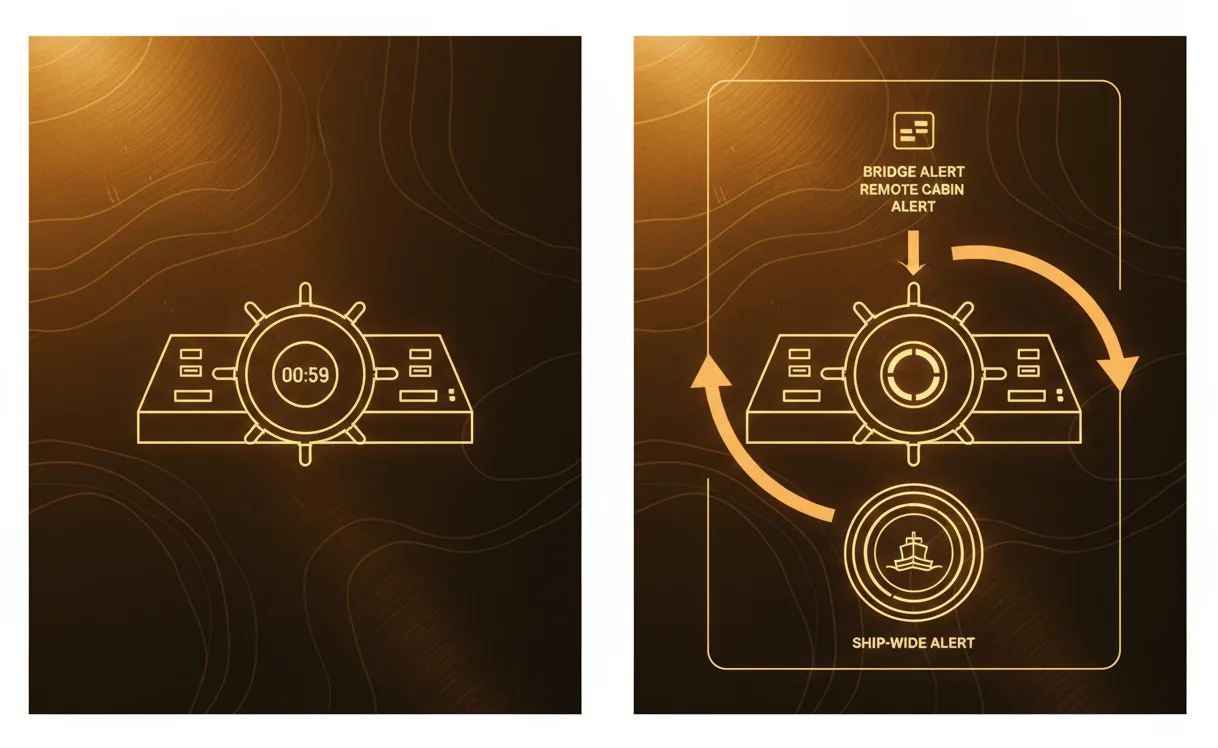
A BNWAS cycle begins with a dormant period, typically adjustable between 3 and 12 minutes. Near the end of that period the system prompts the watchkeeper to reset, usually by a pushbutton or motion sensor. If there is no response, BNWAS triggers a staged alarm sequence, first a visual or audible alert on the bridge, then a remote alarm to backup officers or the Master, then a wider alarm if no one attends. Systems also provide an emergency call so the bridge team can escalate instantly during developing situations. These elements are defined in the IMO performance standard, and many installations follow IEC 62616 test methods alongside the IMO text.
The “Auto” function and autopilot
Most bridges run BNWAS continuously underway. Many systems also include an Auto mode that activates BNWAS when heading or track control is engaged, which aligns with IMO guidance on the Auto function when configured correctly. Treat Auto as a convenience, not a substitute for the SOLAS requirement that BNWAS be in operation when the vessel is at sea.
Why BNWAS matters for yachts
Yachts often operate with small bridge teams, variable routines, and long overnight legs, a perfect recipe for lapses if controls are ad hoc. BNWAS turns discipline into a clear routine, a short reset cadence on the bridge and a predictable call-out if that cadence is missed. For owners and managers, it is a visible control that aligns with international practice, supports audits, and reduces Port State friction when itineraries expand. For crew, it backs up standing orders during quiet hours and keeps help one alarm away, which is exactly when you want redundancy.
BNWAS versus similar features you may already have
Some autopilots include a “watch alarm,” and there are generic dead-man or motion sensors sold for bridge use. Those may boost awareness, but compliance requires a BNWAS that meets MSC.128(75) performance and the SOLAS carriage rule, including staged remote alarms and operation underway. If your yacht falls under SOLAS, or you choose to align voluntarily with class and flag expectations, check your equipment certificates and approvals rather than assuming an autopilot timer is enough.
Practical setup that crews actually use
Intervals that fit the run. Start with a 6 to 8 minute dormant period on open-water transits, then shorten when the workload is high. The goal is rhythm, not nuisance.
Reset points where eyes stay out. Place the primary reset near the conning position, and if you use motion sensors, aim them to capture natural movements at the helm, not head-down tasks.
Escalation that brings the right help. Map the second-stage alarm to cabins or duty spaces where the backup officer will actually hear it, and periodically test the full chain.
Link the habit to voyage routines. Fold BNWAS checks into your pre-departure and night orders, alongside ECDIS route checks and AIS data verification, so watchkeepers treat it as part of navigation, not an add-on.
Refit and commissioning notes that save time
During a refit, BNWAS can be an easy win to modernize the bridge, but only if you treat it like a system. Confirm certification to MSC.128(75) or IEC 62616, document power and alarm circuits, and label reset points on the console drawings. When you run the post-yard sea trial, include a BNWAS end-to-end test: timer prompt, bridge alarm, remote alarm, and cancellation. If the yacht is SOLAS-classed, remember that BNWAS must be in operation whenever underway, so crew familiarization should match the way you actually sail.
Carriage, timelines and scope, the short version
SOLAS V, Regulation 19 introduced phased carriage requirements that brought BNWAS onto passenger ships and cargo ships by size and build date. For older vessels, implementation tied to first surveys in the early 2010s; for newbuilds it applies from delivery. The constant across all phases is simple, BNWAS must conform to IMO performance standards and must operate when the ship is at sea. Large yachts that meet SOLAS thresholds follow the same rule set; smaller or private yachts often adopt BNWAS voluntarily because it standardizes safe practice.
Common pitfalls and how to avoid them
Assuming “Auto” is always enough. Auto that keys off autopilot can be misconfigured or bypassed. Verify compliance with SOLAS’s “in operation underway” requirement, then choose Auto as a convenience, not a crutch.
Silent remote alarms. If the second stage goes to a space no longer used at night, you have a gap. Re-map and test.
Unapproved substitutes. A generic timer is not a BNWAS unless it meets MSC.128(75) performance and your flag accepts it. Check certificates before surveys.
Neglected drills. BNWAS is small, so it often escapes training. Add a five minute BNWAS check to weekly bridge routines, paired with a quick detector or GMDSS check.
Decision points for owners and managers
Compliance scope. Confirm whether your yacht is within SOLAS scope today or might be after a program change. If yes, BNWAS is mandatory. If no, adopting a compliant system is still smart risk management.
Human factors. Choose reset locations and alarm routes that match how your bridge is actually used at night.
Documentation. Keep the approvals, wiring diagrams and test records with your navigation file so Port State and class visits stay short and factual.
Lifecycle support. Pick vendors with spares and service along your cruising track, then schedule a simple function test after software or console changes.
BNWAS is small gear with outsized impact. It keeps the bridge team honest, turns momentary lapses into early alerts, and buys time for a second set of eyes when it matters most. If you are planning a season or a yard period, review your BNWAS against the performance standard, verify alarms and mappings, and build a simple reset rhythm into night orders. The result is a bridge that stays quietly alert, passage after passage.
BNWAS FAQ for Yachts
Does BNWAS have to be on at anchor or only at sea?
SOLAS requires BNWAS to be in operation when the vessel is underway at sea. Many yachts keep it active during coastal transits and approaches too, but at anchor it is usually off unless your standing orders say otherwise. Put the rule in night orders so there is no ambiguity.
What interval should I set for the BNWAS timer?
Choose a dormant period that matches workload and visibility. Six to eight minutes works for open water, then shorten during traffic or poor weather. If you are getting nuisance prompts, the answer is better bridge routines, not disabling the system.
Do motion sensors count as a valid BNWAS reset?
Yes, if they are part of an approved BNWAS and positioned to capture natural conning movements. Avoid sensors that trigger from chart table work or door swings, which defeats the purpose. Keep at least one positive reset near the conning position.
Is the autopilot’s “watch alarm” the same as BNWAS?
No. An autopilot timer is just a reminder, while BNWAS is a certified system with staged bridge and remote alarms, logging, and fail-safes. If your yacht must comply, you need a BNWAS that meets the performance standard, not a standalone timer.
Who is allowed to cancel a BNWAS escalation at night?
The watchkeeper cancels Stage 1 on the bridge, but once a remote alarm sounds, the responding officer should verify the bridge is properly manned before canceling. Keep this flow in your bridge procedures so alarms do not silently die in a cabin.
What is the quickest weekly BNWAS test?
Run a full escalation: allow the bridge prompt, acknowledge late to trigger the bridge alarm, wait for the remote call-out, then cancel correctly. Log the test, location of remote alarms, and any adjustments made. Five minutes validates the whole chain.
How should we map remote alarms so backup arrives fast?
Route the second-stage alarm to the duty officer’s cabin or mess where it will be heard at night. Avoid spaces that are rarely occupied after midnight. Recheck mappings after any refit or crew accommodation change.
Can BNWAS be in “Auto” so it only runs with autopilot engaged?
Many systems offer Auto, which arms BNWAS when heading or track control is on. Treat it as a convenience, not your compliance strategy. Your standing orders should still say BNWAS is in operation whenever the yacht is underway.
Will BNWAS create false alarms in heavy seas?
It can if reset points are too far from the conning position or the timer is too short. Move the primary reset where the helmsman naturally stabilizes, and choose an interval that allows safe hands-on time. Better human factors beat constant resets.
What do PSC or class surveyors check on BNWAS?
They look for type-approval, correct operation underway, and a working escalation path to the backup officer. Expect a quick demo and a review of your logbook or planned maintenance entry. If your procedures rely on Auto, be ready to show compliance when hand steering.
How does BNWAS interact with bridge resource management?
BNWAS backs up BRM by ensuring help arrives before a lapse becomes a hazard. Pair BNWAS with clear night orders, lookout allocation, and fatigue checks. The system is a safety net, not the primary watchkeeping method.
Can I silence the bridge alarm quickly to avoid waking guests?
You can acknowledge Stage 1 on the bridge, but do not suppress escalation when the bridge is unattended. If guest disturbance is a concern, tune volume and tone appropriately, then rely on door closers and acoustic treatments, not shortcuts.
What happens during pilotage, do we still need BNWAS?
Yes, you are still underway. The bridge may be busy, so choose a sensible interval and ensure the officer at the conning position can reset without leaving the pilot exchange. Include BNWAS in the master-pilot information exchange so everyone understands the tones.
Do small private yachts benefit if BNWAS is not mandatory?
Often yes. Night passages with small teams carry real fatigue risk, and a simple escalation to a second crewmember is low-cost protection. Voluntary adoption also standardizes practice if you later charter or change flag.
Can BNWAS be integrated with other alarms on the bridge?
It can share annunciators or panels when supported, but keep the BNWAS alert path distinct enough to avoid masking. Integration should never defeat timing or escalation. Any change needs a function test and an updated diagram.